Tetrahydrofuran → Ethyl 4-{[2-(methylsulfanyl)pyrimidin-5-yl]methyl}quinoline-2-carboxylate
Reaction equation

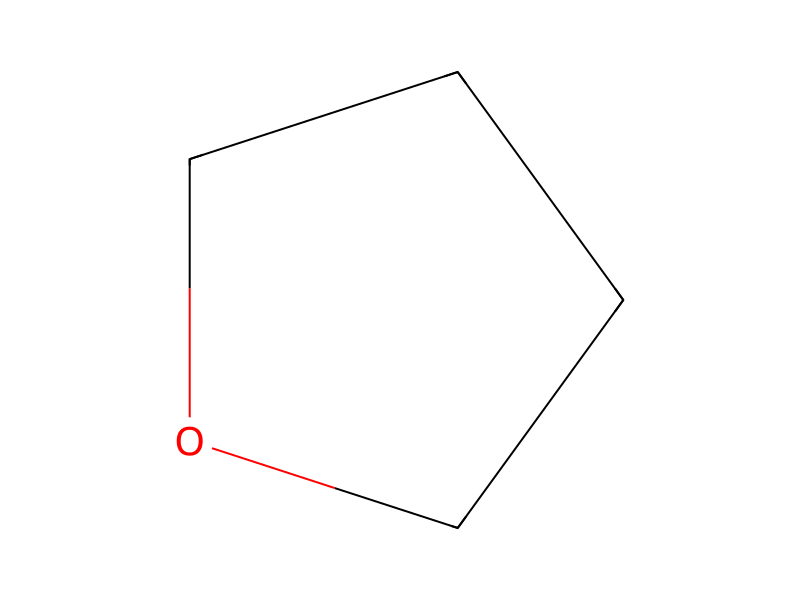
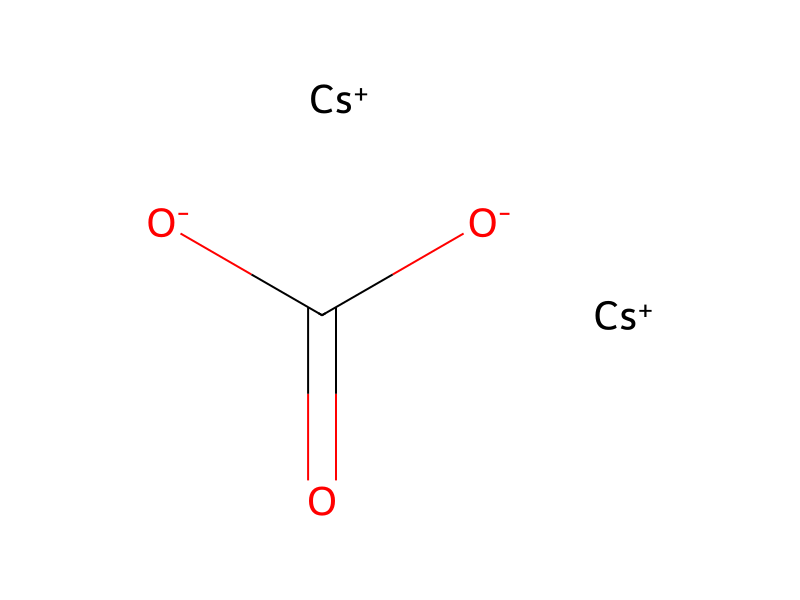
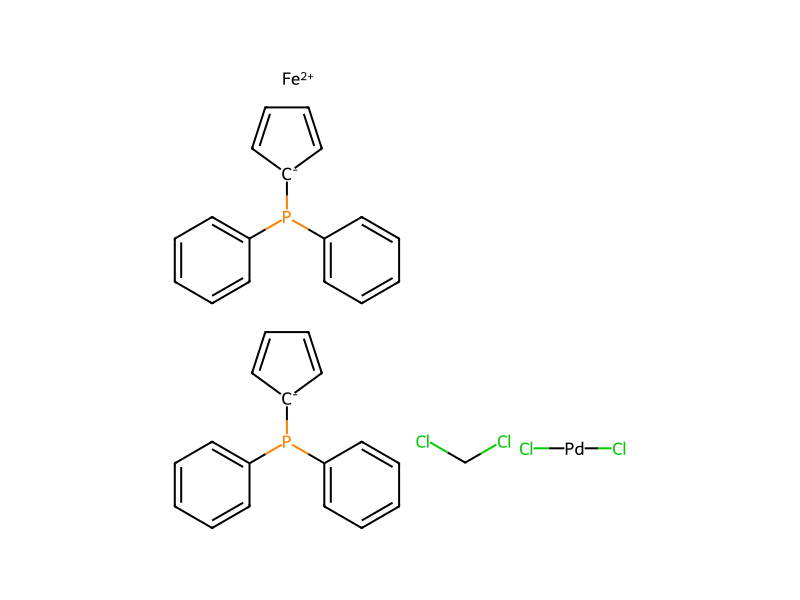
CC1(C)C(C)(C)OB([C:9]2[C:18]3[C:13](=[CH:14][CH:15]=[CH:16][CH:17]=3)[N:12]=[C:11]([C:19]([O:21][CH2:22][CH3:23])=[O:20])[CH:10]=2)O1.Br[CH2:26][C:27]1[CH:28]=[N:29][C:30]([S:33][CH3:34])=[N:31][CH:32]=1.C(=O)([O-])[O-].[Cs+].[Cs+].C1COCC1>C1C=CC(P(C2C=CC=CC=2)[C-]2C=CC=C2)=CC=1.C1C=CC(P(C2C=CC=CC=2)[C-]2C=CC=C2)=CC=1.Cl[Pd]Cl.[Fe+2].C(Cl)Cl.O>[CH3:34][S:33][C:30]1[N:31]=[CH:32][C:27]([CH2:26][C:9]2[C:18]3[C:13](=[CH:14][CH:15]=[CH:16][CH:17]=3)[N:12]=[C:11]([C:19]([O:21][CH2:22][CH3:23])=[O:20])[CH:10]=2)=[CH:28][N:29]=1Participants
Reactant 4


Product 1

Reagents, catalysts & solvents 2
Conditions
- Temperature
- 77 °C
Procedure
In a microwave vial containing ethyl 4-(4,4,5,5-tetramethyl-1,3,2-dioxaborolan-2-yl)quinoline-2-carboxylate (K4) (0.15 g, 0.46 mmol), 5-(bromomethyl)-2-(methylsulfanyl)pyrimidine (N3) (0.12 g, 0.55 mmol), cesium carbonate (0.45 g, 1.4 mmol), and PdCl2(dppf)-CH2Cl2 adduct (0.037 g, 0.05 mmol) was added 4.1 mL THF and 0.41 mL water. The reaction mixture was heated to 77° C. for 1 h. The reaction mixture was cooled to room temperature, quenched with water, extracted with ethyl acetate, washed with brine, dried over sodium sulfate, filtered, and concentrated. The resultant residue was subjected to silica gel chromatography eluting with 0-70% ethyl acetate in hexanes to afford ethyl 4-{[2-(methylsulfanyl)pyrimidin-5-yl]methyl}quinoline-2-carboxylate (N4) that gave a mass ion (ES+) of 340.3 for M+H+. The above compound was converted to the titled compound by the procedure described in Example 11 that gave proton NMR spectra consistent with theory and a mass ion (ES+) of 411.1481 for M+H30 . 1H NMR (400 MHz, CDCl3) δ 8.42 (s, 2H), 8.37 (d, J=6.4 Hz, 1H), 8.19 (d, J=8.2 Hz, 1H), 8.14 (s, 1H), 7.99 (d, J=8.4 Hz, 1H), 7.84-7.80 (m, 1H), 7.70-7.66 (m, 1H), 4.44 (s, 2H), 4.13 (dd, J=4.9, 11.2 Hz, 1H), 4.08-4.00 (m, 2H), 3.77-3.71 (m, 1H), 3.55-3.49 (m, 1H), 3.30-3.25 (m, 1H), 2.54 (s, 3H), 2.15-2.11 (m, 1H) 1.95-1.85 (m, 1H).
Workup
- temperatureThe reaction mixture was cooled to room temperature
- customquenched with water
- extractionextracted with ethyl acetate
- washwashed with brine
- dry with materialdried over sodium sulfate
- filtrationfiltered
- concentrationconcentrated
- washeluting with 0-70% ethyl acetate in hexanes
Sources & evidence
- ORD record
- ord-152cef85e598459bb67cfe31177e127f
- Source dataset
- uspto-grants-2015_12
- Patent number
- US09199939B2
Reaction notes
Loading…