Water → HCID 131734214, compound
Reaction equation

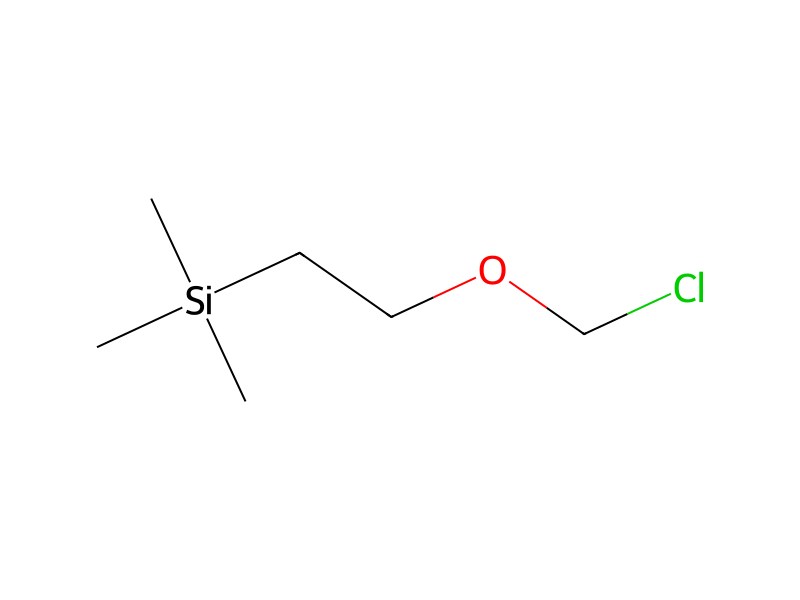
[Cl:1][C:2]1[CH:7]=[C:6]([OH:8])[CH:5]=[CH:4][C:3]=1[NH:9][C:10](=[O:19])[O:11][CH2:12][C:13]1[CH:18]=[CH:17][CH:16]=[CH:15][CH:14]=1.C(N(C(C)C)CC)(C)C.Cl[CH2:30][O:31][CH2:32][CH2:33][Si:34]([CH3:37])([CH3:36])[CH3:35].O>ClCCl.[I-].C([N+](CCCC)(CCCC)CCCC)CCC>[Cl:1][C:2]1[CH:7]=[C:6]([O:8][CH2:30][O:31][CH2:32][CH2:33][Si:34]([CH3:37])([CH3:36])[CH3:35])[CH:5]=[CH:4][C:3]=1[NH:9][C:10](=[O:19])[O:11][CH2:12][C:13]1[CH:14]=[CH:15][CH:16]=[CH:17][CH:18]=1Participants
7





Procedure
To a solution of benzyl (2-chloro-4-hydroxyphenyl)carbamate (9.26 g) in dichloromethane (100 mL) were added tetra-n-butylammonium iodide (12.3 g), diisopropyl ethylamine (11.4 mL), and [2-(chloromethoxy)ethyl](trimethyl)silane (11.8 mL) under ice-cooling, followed by stirring at room temperature for 2 hours. To the reaction mixture was added water, followed by extraction with ethyl acetate. The organic layer was dried over anhydrous sodium sulfate and concentrated under reduced pressure. The residue was purified by silica gel column chromatography (hexane-ethyl acetate) to obtain benzyl (2-chloro-4-{[2-(trimethylsilyl)ethoxy]methoxy}phenyl)carbamate (10.3 g).
Workup
- temperaturecooling
- extractionfollowed by extraction with ethyl acetate
- dry with materialThe organic layer was dried over anhydrous sodium sulfate
- concentrationconcentrated under reduced pressure
- customThe residue was purified by silica gel column chromatography (hexane-ethyl acetate)
Sources & evidence
- ORD record
- ord-8f110498ad30434f8fcad73d4df4b413
- Source dataset
- uspto-grants-2015_12
- Patent number
- US09199927B2
Reaction notes
Loading…