Cesium carbonate → 4-Cyclopropyl-2-fluoro-1-nitrobenzene
Reaction equation

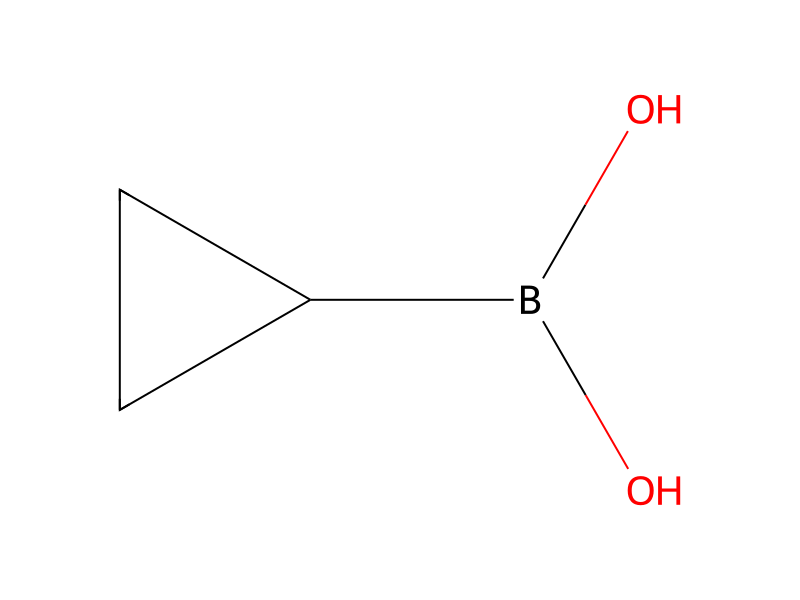
[F:1][C:2]1[CH:3]=[C:4](OS(C(F)(F)F)(=O)=O)[CH:5]=[CH:6][C:7]=1[N+:8]([O-:10])=[O:9].[CH:19]1(B(O)O)[CH2:21][CH2:20]1.C(=O)([O-])[O-].[Cs+].[Cs+]>C1(C)C=CC=CC=1>[CH:19]1([C:4]2[CH:5]=[CH:6][C:7]([N+:8]([O-:10])=[O:9])=[C:2]([F:1])[CH:3]=2)[CH2:21][CH2:20]1Participants




Conditions
- Temperature
- 90 °C
Procedure
A stirred suspension of trifluoro-methanesulfonic acid 3-fluoro-4-nitro-phenyl ester (5.6 g, 19 mmol), cyclopropyl boronic acid (2.09 g, 23.3 mmol) Pd(dppf)Cl2 (1.24 g, 1.5 mmol) and 2M aqueous cesium carbonate (30 mL, 60 mmol) in toluene (20 mL) was degassed before being heated at 90° C. under an argon atmosphere for 2.5 hours. The reaction mixture was allowed to cool to room temperature before filtering through a pad of Celite®, washing with ethyl acetate. The filtrate was washed (water, brine), and then dried (MgSO4), filtered and concentrated in vacuo. The resultant residue was subjected to flash chromatography (Si-PPC, gradient 0-30% ethyl acetate in pentane) to give the title compound as a yellow solid (2.79 g, 81%). 1H NMR (DMSO-d6, 400 MHz) 8.03 (1 H, t, J=8.39 Hz), 7.28 (1 H, dd, J=13.19, 1.91 Hz), 7.16 (1 H, dd, J=8.61, 1.90 Hz), 2.14-2.05 (1 H, m), 1.21-1.05 (2 H, m), 0.92-0.82 (2 H, m).
Workup
- customwas degassed
- temperatureto cool to room temperature
- filtrationbefore filtering through a pad of Celite®
- washwashing with ethyl acetate
- washThe filtrate was washed (water, brine)
- dry with materialdried (MgSO4)
- filtrationfiltered
- concentrationconcentrated in vacuo
Sources & evidence
- ORD record
- ord-228667c958c544249c294bda5fdc5134
- Source dataset
- uspto-grants-2015_12
- Patent number
- US09206174B2
Reaction notes
Loading…