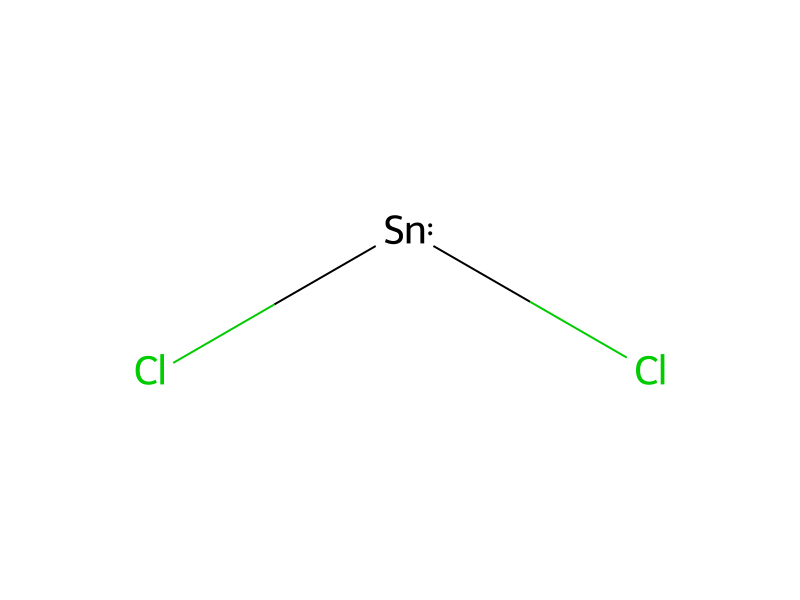
Stannous Chloride → trans-4-Aminostilbene
Reaction equation

[CH:1]1[CH:6]=[CH:5][C:4](/[CH:7]=[CH:8]/[C:9]2[CH:14]=[CH:13][C:12]([N+:15]([O-])=O)=[CH:11][CH:10]=2)=[CH:3][CH:2]=1.[Sn](Cl)Cl>Cl.CC(C)=O>[CH:1]1[CH:2]=[CH:3][C:4](/[CH:7]=[CH:8]/[C:9]2[CH:10]=[CH:11][C:12]([NH2:15])=[CH:13][CH:14]=2)=[CH:5][CH:6]=1Participants
Reactant 2

Product 1

Reagents, catalysts & solvents 2


Procedure
In an embodiment of the invention, a method for preparing the aforesaid alignment film in a laboratory level is illustrated as an example. 10 g of 4-nitrobenzyl bromide is mixed with 12 g of triphenylphosphine and dissolved in 150 ml of a dry tetrahydrofuran solution, heated to 75° C. and agitated under reflux for 48 hours, to obtain 8.2 g of a dry white p-nitrobenzyl triphenylphosphine. The p-nitrobenzyl triphenylphosphine is mixed with 2.6 g of p-nitrobenzaldehyde in a 150 ml tetrahydrofuran solution, and agitated under room temperature for about 24 hours to obtain 4.2 g of p-nitrostilbene. The resultant p-nitrostilbene is mixed with 14.7 g of tin dichloride, dissolved in a mixed solution of 30 ml/40% hydrochloride acid and 100 ml acetone, agitated under the room temperature for about 2 hours and refluxed for 8 hours to obtain p-aminostilbene. The p-aminostilbene is mixed with 9,9′-bianthracyl tetracarboxylic dianhydride in a dry NMP (N-methyl-pyrrolidone) solution under agitation for 24 hours, under protection of nitrogen gas, to obtain the precursor of the polyimide alignment film involved in the embodiment. The precursor is heated to 230° C. to obtain the final alignment film, which is a light sensitive alignment film.
Workup
- temperaturerefluxed for 8 hours
Sources & evidence
- ORD record
- ord-cbda2561fb2747ae83209fccde494215
- Source dataset
- uspto-grants-2015_12
- Patent number
- US09207497B2
Reaction notes
Loading…