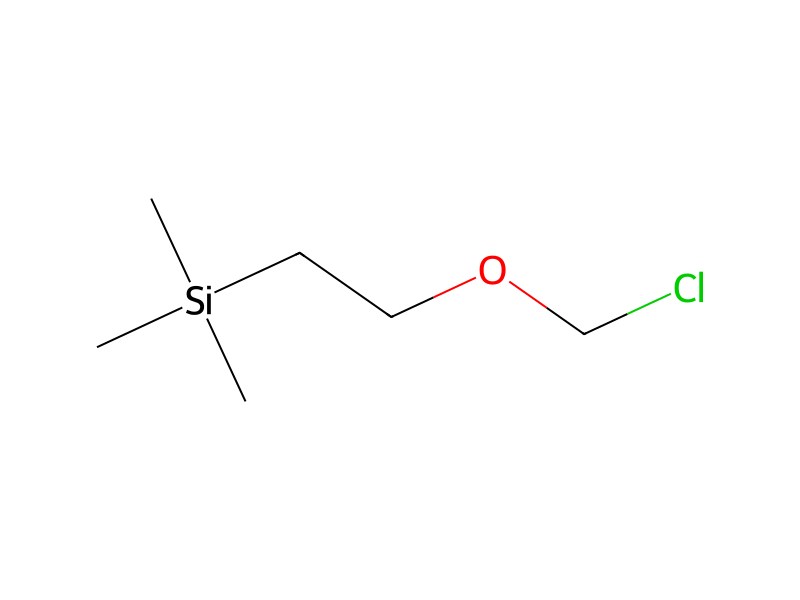
2-Chloromethyl 2-(trimethylsilyl)ethyl ether → HCID 86725368, compound
Reaction equation

[Cl:1][C:2]1[C:7]2[N:8]=[CH:9][NH:10][C:6]=2[C:5]([C:11]#[N:12])=[C:4]([Cl:13])[N:3]=1.[CH3:14][Si:15]([CH3:22])([CH3:21])[CH2:16][CH2:17][O:18][CH2:19]Cl>C(N(CC)CC)C>[Cl:1][C:2]1[C:7]2[N:8]=[CH:9][N:10]([CH2:19][O:18][CH2:17][CH2:16][Si:15]([CH3:22])([CH3:21])[CH3:14])[C:6]=2[C:5]([C:11]#[N:12])=[C:4]([Cl:13])[N:3]=1Participants
Reactant 2

Product 1

Reagents, catalysts & solvents 1

Procedure
2,6-Dichloropyridin-4-amine can be added in portions to concentrated sulfuric acid, followed by the addition of fuming nitric acid to provide 2,6-dichloro-3-nitropyridin-4-amine. The reaction is typically performed at reduced temperature before warming to ambient temperature. 2,6-Dichloro-3-nitropyridin-4-amine can be reacted with N-bromosuccinimide in acetic acid to provide 3-bromo-2,6-dichloro-5-nitropyridin-4-amine. The reaction is typically performed at elevated temperature. Reduction of -bromo-2,6-dichloro-5-nitropyridin-4-amine with Raney nickel and hydrogen gas can provide 5-bromo-2,6-dichloropyridine-3,4-diamine. The reaction may be performed at ambient temperature in a solvent such as but not limited to ethanol. 7-Bromo-4,6-dichloro-1H-imidazo[4,5-c]pyridine can be prepared by reacting 5-bromo-2,6-dichloropyridine-3,4-diamine with triethyl orthoformate and acetic anhydride. The reaction is typically performed at elevated temperature. N,N,N′,N′-Tetramethylethylenediamine can be added to 7-bromo-4,6-dichloro-1H-imidazo[4,5-c]pyridine followed by the addition of n-butyllithium and then dry carbon dioxide gas to provide 4,6-dichloro-1H-imidazo[4,5-c]pyridine-7-carboxylic acid. The reaction is typically performed at reduced temperature in a solvent such as but not limited to tetrahydrofuran, hexane, and the like, or mixtures thereof. A mixture of 4,6-dichloro-1H-imidazo[4,5-c]pyridine-7-carboxylic acid and thionyl chloride can be refluxed together and concentrated, followed by the addition of aqueous ammonia at reduced temperature in a solvent such as but not limited to tetrahydrofuran to provide 4,6-dichloro-1H-imidazo[4,5-c]pyridine-7-carboxamide. Phosphorus oxychloride can be reacted with 4,6-dichloro-1H-imidazo[4,5-c]pyridine-7-carboxamide at elevated temperature to provide 4,6-dichloro-1H-imidazol-[4,5-c]pyridine-7-carbonitrile. A base such as but not limited to triethylamine can be reacted with 4,6-dichloro-1H-imidazo[4,5-c]pyridine-7-carbonitrile, followed by the addition of 2-(trimethylsilyl)ethoxymethyl chloride to provide 4,6-dichloro-1-((2-(trimethylsilyl)ethoxy)methyl)-1H-imidazo[4,5-c]pyridine-7-carbonitrile. The reaction is typically performed at low temperature followed by warming to ambient temperature, in a solvent such as but not limited to tetrahydrofuran. Compounds of formula (12), can be prepared by reacting 4,6-dichloro-1-((2-(trimethylsilyl)ethoxy)methyl)-1H-imidazo[4,5-c]pyridine-7-carbonitrile with an organozinc compound of formula (2A), wherein Z, A, R1, and n are as described herein and XA is a halide. The reaction typically involves the use of heat and a nickel or palladium catalyst such as but not limited to bis(triphenylphosphine)palladium(II) dichloride or tetrakis(triphenylphosphine)palladium(0) in a solvent such as but not limited to N-methylpyrrolidone, tetrahydrofuran, or mixtures thereof. A compound of formula (IA) wherein B, R2, R3, and m are as described herein, can be reacted with compounds of formula (12) in the presence of a base such as but not limited to N,N-diisopropylethylamine or cesium carbonate to provide compounds of formula (13). The reaction typically requires the use of heat and a solvent such as but not limited to 1,4-dioxane or toluene. Compounds of formula (13) can be heated in a mixture of concentrated sulfuric acid and water to provide compounds of formula (14), which are representative of the compounds of Formula (I).
Sources & evidence
- ORD record
- ord-6ced0662ecd94b7caa19abeb1490b71f
- Source dataset
- uspto-grants-2015_12
- Patent number
- US09212192B2
Reaction notes
Loading…