Potassium Phosphate, Tribasic → 2-Chloro-4-methoxytoluene
Reaction equation

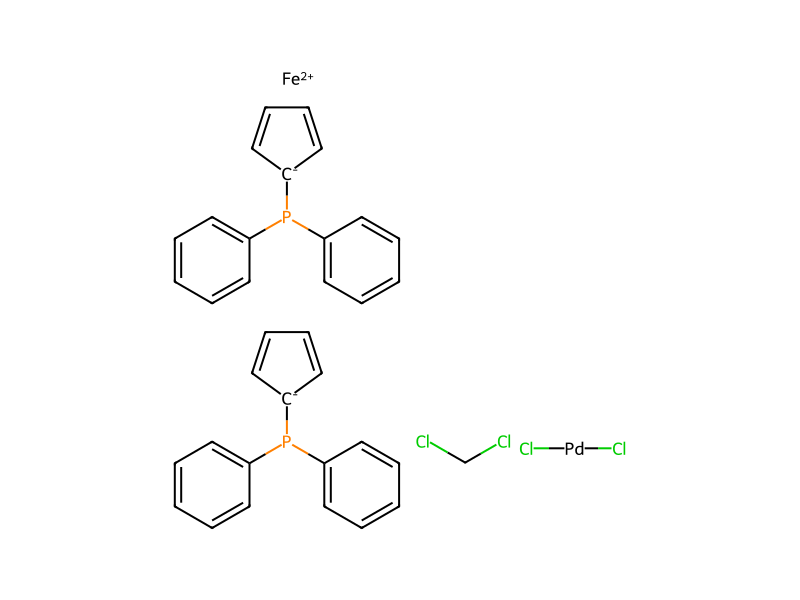
[CH3:1]B(O)O.Br[C:6]1[CH:11]=[CH:10][C:9]([O:12][CH3:13])=[CH:8][C:7]=1[Cl:14].P([O-])([O-])([O-])=O.[K+].[K+].[K+]>O1CCOCC1.O.CCCCCCC.C1C=CC(P(C2C=CC=CC=2)[C-]2C=CC=C2)=CC=1.C1C=CC(P(C2C=CC=CC=2)[C-]2C=CC=C2)=CC=1.Cl[Pd]Cl.[Fe+2].C(Cl)Cl>[Cl:14][C:7]1[CH:8]=[C:9]([O:12][CH3:13])[CH:10]=[CH:11][C:6]=1[CH3:1]Participants
8
Reactant 3



Product 1

Reagents, catalysts & solvents 4



Procedure
A solution of PdCl2(dppf)-DCM adduct (0.922 g, 1.129 mmol), methylboronic acid (2.70 g, 45.2 mmol), 4-bromo-3-chloroanisole (6.39 ml, 45.2 mmol), and potassium phosphate (28.8 g, 135 mmol) in 150 mL dioxane and 50 mL water was heated to 110° C. for 2 hours. The reaction mixture was then diluted with heptane, the organics dried over MgSO4 and concentrated to afford 2-chloro-4-methoxy-1-methylbenzene. m/z (ESI) 141.0 (M−CH3)+.
Workup
- dry with materialthe organics dried over MgSO4
- concentrationconcentrated
Sources & evidence
- ORD record
- ord-d6d0f1dc4f864c03a9e4c117381e18c0
- Source dataset
- uspto-grants-2015_12
- Patent number
- US09212182B2
Reaction notes
Loading…