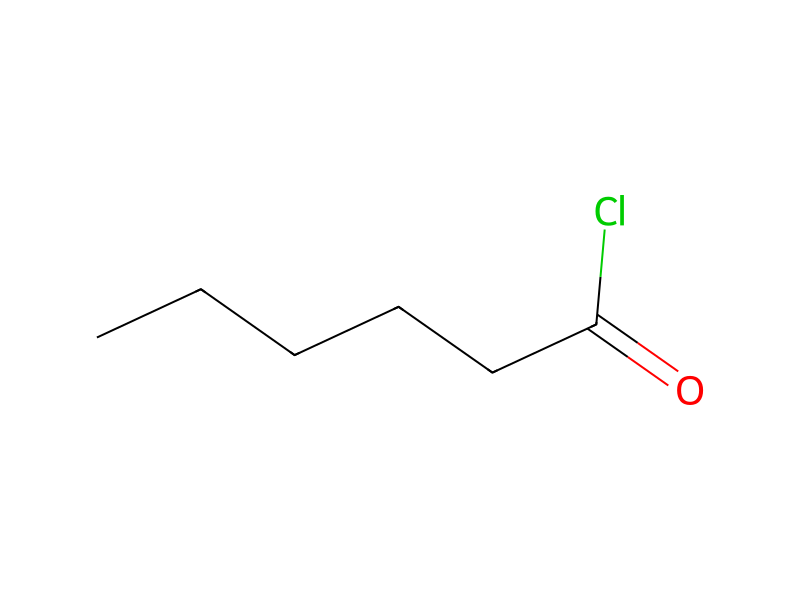
Hexanoyl chloride → N-(6-bromo-1-oxo-1,2,3,4-tetrahydronaphthalen-2-yl)hexanamide
Reaction equation

Cl.[NH2:2][CH:3]1[CH2:12][CH2:11][C:10]2[C:5](=[CH:6][CH:7]=[C:8]([Br:13])[CH:9]=2)[C:4]1=[O:14].C(N(C(C)C)CC)(C)C.[C:24](Cl)(=[O:30])[CH2:25][CH2:26][CH2:27][CH2:28][CH3:29]>ClCCl>[Br:13][C:8]1[CH:9]=[C:10]2[C:5](=[CH:6][CH:7]=1)[C:4](=[O:14])[CH:3]([NH:2][C:24](=[O:30])[CH2:25][CH2:26][CH2:27][CH2:28][CH3:29])[CH2:12][CH2:11]2Participants




Procedure
To 2-amino-6-bromo-3,4-dihydronaphthalen-1(2H)-one hydrochloride (Preparation 82B, 1.1 g, 3.98 mmol) in dichloromethane (5 mL) was added diisopropylethylamine (1.737 mL, 9.94 mmol) at 0° C. under a nitrogen atmosphere. To the homogenous solution was added hexanoyl chloride (0.602 mL, 4.38 mmol) dropwise over a period of 3 min. The reaction mixture was allowed to come to room temperature (˜5 min.) and was stirred at room temperature for 3 h. The reaction mixture was partitioned between dichloromethane (30 mL) and 1N HCl (10 mL). The dichloromethane layer was separated, washed with sat. aq. NaHCO3 (20 mL), dried over sodium sulfate and concentrated to yield N-(6-bromo-1-oxo-1,2,3,4-tetrahydronaphthalen-2-yl)hexanamide (1.2 g, 3.55 mmol, 89% yield) as an off-white solid. LC/MS M+1 339.
Workup
- customto come to room temperature
- custom(˜5 min.)
- customThe reaction mixture was partitioned between dichloromethane (30 mL) and 1N HCl (10 mL)
- customThe dichloromethane layer was separated
- washwashed with sat. aq. NaHCO3 (20 mL)
- dry with materialdried over sodium sulfate
- concentrationconcentrated
Sources & evidence
- ORD record
- ord-abdadf7a34ba42dbaf6213f6d46bf2ad
- Source dataset
- uspto-grants-2015_12
- Patent number
- US09216972B2
Reaction notes
Loading…