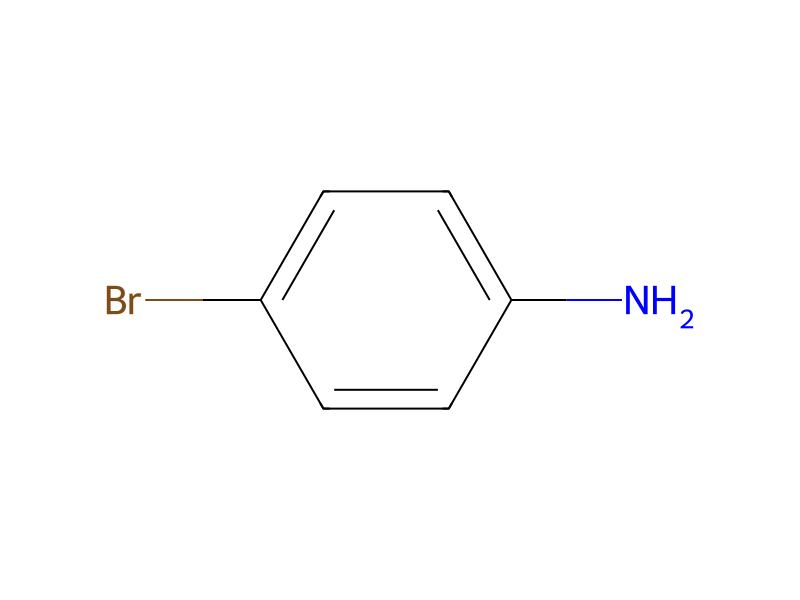
4-Bromoaniline → 6-Bromo-4-hydroxyquinolin-2(1H)-one
Reaction equation

BrC1C=CC(N)=CC=1.CC1(C)OC(=O)CC(=O)O1.[Br:19][C:20]1[CH:25]=[CH:24][C:23]([NH:26][C:27](=[O:32])[CH2:28][C:29]([OH:31])=O)=[CH:22][CH:21]=1.CS(O)(=O)=O.O=P12OP3(OP(OP(O3)(O1)=O)(=O)O2)=O>O>[Br:19][C:20]1[CH:21]=[C:22]2[C:23](=[CH:24][CH:25]=1)[NH:26][C:27](=[O:32])[CH:28]=[C:29]2[OH:31]Participants



Conditions
- Temperature
- 80 °C
Procedure
According to the general method described in Synthetic Communications 2010, 40, 732, a mixture of 4-bromoaniline (30.0 g, 174 mmol) and 2,2-dimethyl-1,3-dioxan-4,6-dione (25.1 g, 174 mmol) was heated to 80° C. for 1.5 hours and cooled to ambient temperature to receive 3-((4-bromophenyl)amino)-3-oxopropanoic acid. The acetone byproduct was removed under vacuum to provide the intermediate product as a dry solid. Eaton's reagent (100 mL) was added to the solid and the resulting mixture heated to 70° C. overnight then cooled to room temperature. The mixture was poured into water and the brown precipitate was filtered and rinsed with water. The brown precipitate was triturated with ethanol, then filtered to provide the title compound as a light brown solid.
Workup
- temperaturecooled to ambient temperature
- customThe acetone byproduct was removed under vacuum
- customto provide the intermediate product as a dry solid
- temperaturethe resulting mixture heated to 70° C. overnight
- temperaturethen cooled to room temperature
- filtrationthe brown precipitate was filtered
- washrinsed with water
- customThe brown precipitate was triturated with ethanol
- filtrationfiltered
Sources & evidence
- ORD record
- ord-a9772e451f44434cb8eacf362b49044c
- Source dataset
- uspto-grants-2015_12
- Patent number
- US09221804B2
Reaction notes
Loading…