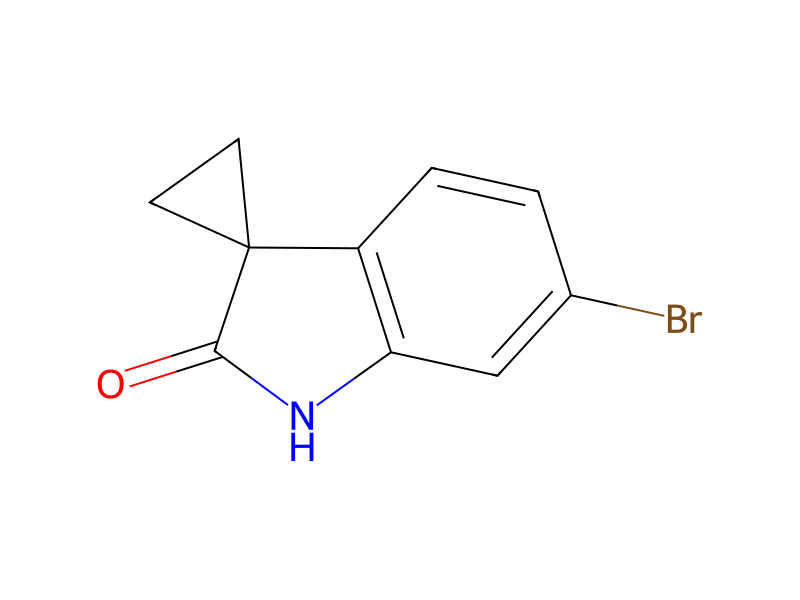
1,2-Dibromoethane → 6'-Bromo-1'H-spiro[cyclopropane-1,3'-indole]-2'-one
Reaction equation

[Br:1][C:2]1[CH:10]=[C:9]2[C:5]([CH2:6][C:7](=[O:11])[NH:8]2)=[CH:4][CH:3]=1.[CH:12](NC(C)C)(C)[CH3:13].[Li]CCCC.BrCCBr>O1CCCC1>[Br:1][C:2]1[CH:10]=[C:9]2[C:5]([C:6]3([CH2:13][CH2:12]3)[C:7](=[O:11])[NH:8]2)=[CH:4][CH:3]=1Participants





Conditions
- Temperature
- 0 °C
Procedure
A solution of 6-bromoindolin-2-one (2 g, 9.43 mmol) and diisopropylamine (2.00 g, 2.82 ml, 19.8 mmol) in tetrahydrofuran (16 ml) was cooled to −25° C. and a solution of nBuLi (1.6 M in hexane, 23.6 ml, 37.7 mmol) was added dropwise. The reaction mixture was warmed to 0° C. and a solution of 1,2-dibromoethane (5.32 g, 2.44 ml, 28.3 mmol) in tetrahydrofuran (2 ml) was added dropwise. The reaction mixture was warmed to room temperature, stirred for 20 hours and carefully quenched with brine (2 ml) and conc. HCl (2 ml, ice bath). The reaction mixture was diluted with tert-butyl methyl ether and water. The aqueous phase was extracted with tert-butyl methyl ether, the combined organic phases were washed with brine and dried over sodium sulfate. The solvent was evaporated and the residue purified by silica gel chromatography using ethyl acetate/heptane as eluent. The title compound was obtained as red crystals (1.11 g).
Workup
- temperatureThe reaction mixture was warmed to room temperature
- customcarefully quenched with brine (2 ml) and conc. HCl (2 ml, ice bath)
- additionThe reaction mixture was diluted with tert-butyl methyl ether and water
- extractionThe aqueous phase was extracted with tert-butyl methyl ether
- washthe combined organic phases were washed with brine
- dry with materialdried over sodium sulfate
- customThe solvent was evaporated
- customthe residue purified by silica gel chromatography
Sources & evidence
- ORD record
- ord-f0c690ab429340f0885379580e5d86eb
- Source dataset
- uspto-grants-2015_12
- Patent number
- US09221816B2
Reaction notes
Loading…