Butyl bromide → 1-Butoxy-2,3-Difluorobenzene
Reaction equation

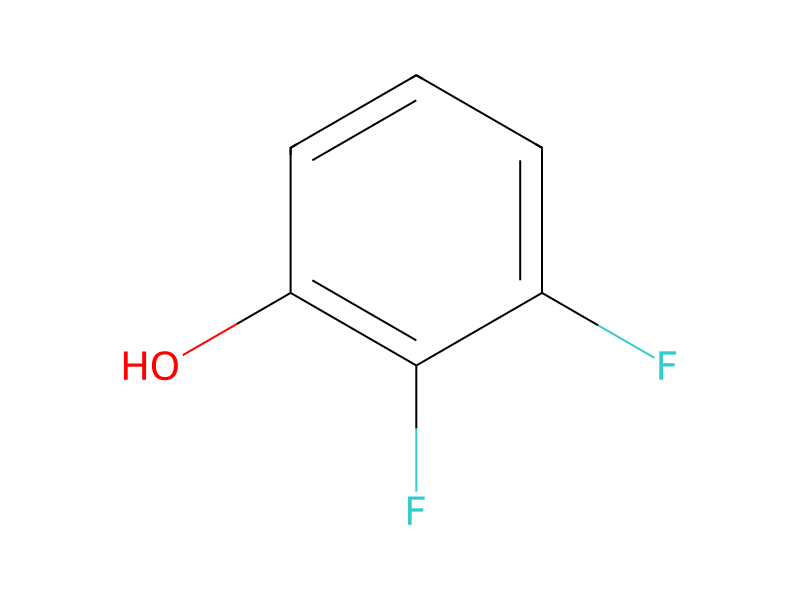
[F:1][C:2]1[C:7]([F:8])=[CH:6][CH:5]=[CH:4][C:3]=1[OH:9].[OH-].[Na+].Br[CH2:13][CH2:14][CH2:15][CH3:16]>O.CCCCCCC>[CH2:13]([O:9][C:3]1[CH:4]=[CH:5][CH:6]=[C:7]([F:8])[C:2]=1[F:1])[CH2:14][CH2:15][CH3:16]Participants
Reactant 3


Product 1

Reagents, catalysts & solvents 2


Conditions
- Temperature
- 30 °C
Procedure
2,3-Difluorophenol (21) (100.0 g) and sodium hydroxide (NaOH; 36.9 g) were added to water (300 ml) under a nitrogen atmosphere, and the stirring was continued at 70° C. 1-Bromobutane (158.0 g) was added thereto, and the stirring was continued at 70° C. for 2 hours. The reaction mixture obtained was cooled to 30° C., heptane (100 ml) and water (100 ml) were added, and mixed. The mixture was then allowed to separate into organic and aqueous phases. The extraction into an organic phase was carried out. The organic phase obtained was washed with brine and dried over anhydrous magnesium sulfate. Then, fractional distillation was carried out under reduced pressure, giving 114.4 g of 4-butoxy-2,3-difluorobenzene (22). The compound (22) obtained was a colorless oil having a boiling point of 109° C. to 110° C./20 mmHg. The yield based on the compound (21) was 80.0%.
Workup
- customwas continued at 70° C
- customThe reaction mixture obtained
- additionmixed
- customto separate into organic and aqueous phases
- extractionThe extraction into an organic phase
- customThe organic phase obtained
- washwas washed with brine
- dry with materialdried over anhydrous magnesium sulfate
- distillationThen, fractional distillation
Sources & evidence
- ORD record
- ord-5505fad798d240c99a94a469200847b5
- Source dataset
- uspto-grants-2012_07
- Patent number
- US08216489B2
Reaction notes
Loading…