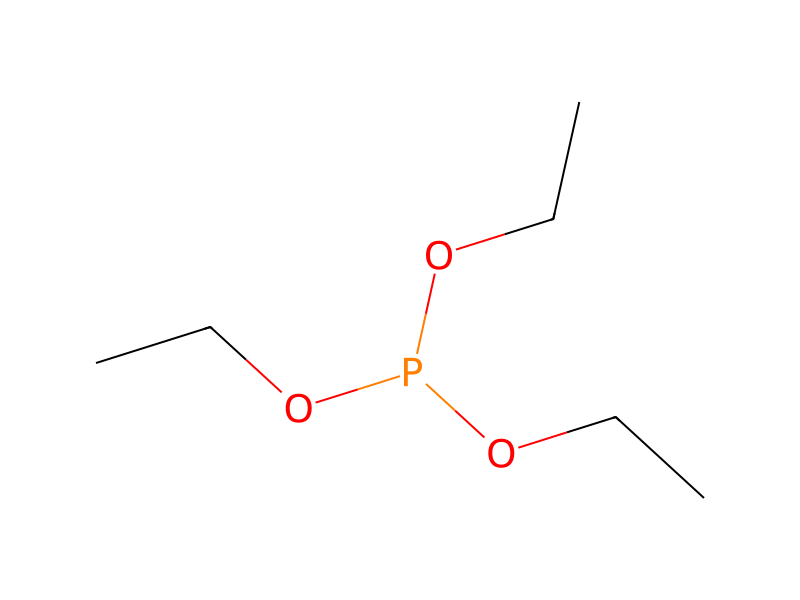
Triethyl phosphite → Diethyl [(2-iodophenyl)methyl]phosphonate
Reaction equation

[P:1]([O:8][CH2:9][CH3:10])([O:5][CH2:6][CH3:7])[O:2]CC.[I:11][C:12]1[CH:19]=[CH:18][CH:17]=[CH:16][C:13]=1[CH2:14]Cl>C1(C)C(C)=CC=CC=1>[CH2:9]([O:8][P:1]([CH2:14][C:13]1[CH:16]=[CH:17][CH:18]=[CH:19][C:12]=1[I:11])(=[O:2])[O:5][CH2:6][CH3:7])[CH3:10]Participants
4
Reactant 2

Product 1

Reagents, catalysts & solvents 1

Procedure
Triethyl phosphite (ca 66.6 ml; 94% pure; ca. 396.8 mmol) and 2-iodobenzyl chloride 1 (100 g, 400 mmol; melted prior to use) were mixed with xylene (65 ml) in a 250 ml roundbottomed flask. The clear solution was heated to reflux while stirring for 24 hours. The reaction was followed by GC and 1H-NMR (CDCl3). The disappearing proton resonance of 2H, s, CH2I at 4.73 ppm and the new 2H, d, CH2PO(OEt)2 at 3.47 ppm were indicative for the progress of the reaction.
Workup
- temperatureThe clear solution was heated
- temperatureto reflux
- customCH2PO(OEt)2 at 3.47 ppm were indicative for the progress of the reaction
Sources & evidence
- ORD record
- ord-a36a48e2ff8f47c0a8bc18738a56eba3
- Source dataset
- uspto-grants-2012_07
- Patent number
- US08227623B2
Reaction notes
Loading…