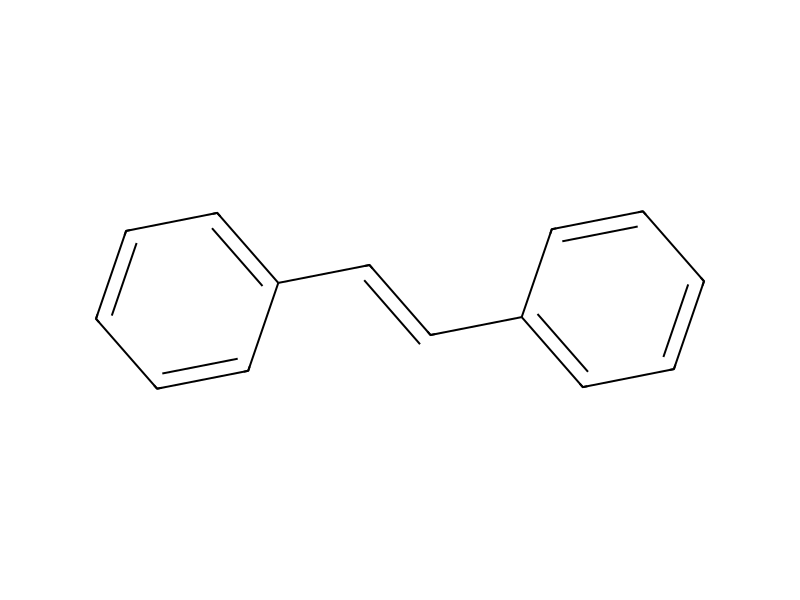
Styrene → trans-Stilbene
Reaction equation

[CH2:1]=[CH:2][C:3]1[CH:8]=[CH:7][CH:6]=[CH:5][CH:4]=1>Cl[Ru](=C1N(C2C(C)=CC(C)=CC=2C)CCN1C1C(C)=CC(C)=CC=1C)(Cl)(=CC1C=CC=CC=1)[P](C1CCCCC1)(C1CCCCC1)C1CCCCC1>[C:3]1(/[CH:2]=[CH:1]/[C:3]2[CH:8]=[CH:7][CH:6]=[CH:5][CH:4]=2)[CH:8]=[CH:7][CH:6]=[CH:5][CH:4]=1Participants
3
Reactant 1

Product 1
Reagents, catalysts & solvents 1

Procedure
Reaction of styrene with Grubbs' second generation catalyst for 19 hours gave the title compound in 94% yield. The 1H and 13C NMR spectra agreed with those reported in the literature. 1H NMR (CDCl3): 7.11 (s, 2H), 7.25 (tt, 2H, J=7.2, 1.2 Hz), 7.34 (m, 4H), 7.50 (m, 413C NMR (CDCl3): 126.51, 127.62, 128.65, 128.68, 137.28.
Sources & evidence
- ORD record
- ord-47f4a25793754fb5809ad7ecfaf8bdae
- Source dataset
- uspto-grants-2012_07
- Patent number
- US08227635B2
Reaction notes
Loading…