Hydrochloric Acid → 3-[3-(Trifluoromethyl)phenoxy]propanoic acid
Reaction equation

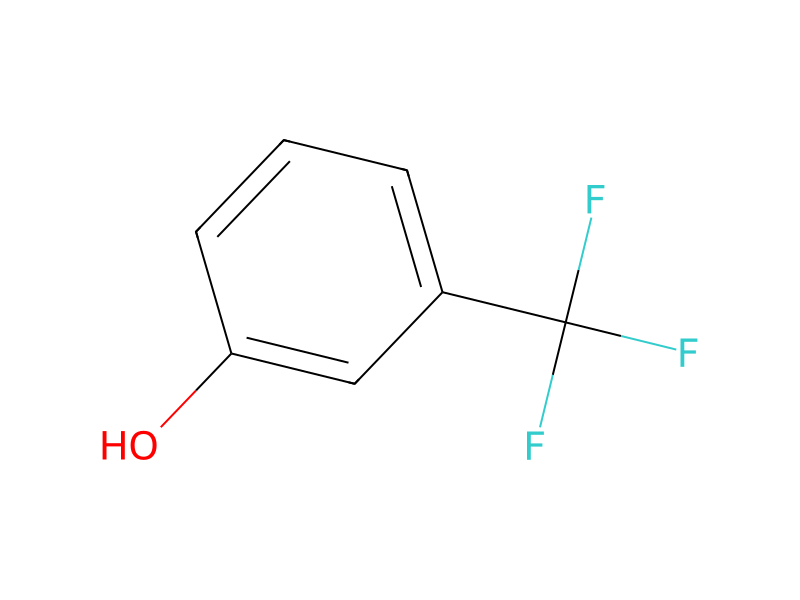
[F:1][C:2]([F:11])([F:10])[C:3]1[CH:4]=[C:5]([OH:9])[CH:6]=[CH:7][CH:8]=1.Br[CH2:13][CH2:14][C:15]([OH:17])=[O:16].Cl>O.[OH-].[Na+]>[F:1][C:2]([F:10])([F:11])[C:3]1[CH:4]=[C:5]([CH:6]=[CH:7][CH:8]=1)[O:9][CH2:13][CH2:14][C:15]([OH:17])=[O:16]Participants





Procedure
Sodium hydroxide (4.24 g, 106 mmol) was dissolved in water (50 ml). 3-Trifluoromethyl-phenol (5.19 g, 32 mmol) was dissolved in 25 ml of the sodium hydroxide solution and heated to reflux. 3-Bromopropionic acid (9.79g, 64 mmol) in the other 25 ml of sodium hydroxide solution was added dropwise over 15 minutes. The reflux was continued for 45 minutes more, with portions of 10M sodium hydroxide solution added to maintain the pH of the solution at appoximately pH 10. The reaction mixture was then cooled, acidified with hydrochloric acid, and extracted with ethyl acetate. The combined organic layers were extracted with saturated aqueous sodium bicarbonate, and the aqueous layers acidified with hydrochloric acid. The acidified aqueous layers were extracted with diethyl ether. The ether layers were dried with magnesium sulfate, and the solvent removed under vacuum to give 2.5 g of the crude product which was used directly in the next step.
Workup
- temperatureheated to reflux
- temperatureto maintain the pH of the solution at appoximately pH 10
- temperatureThe reaction mixture was then cooled
- extractionextracted with ethyl acetate
- extractionThe combined organic layers were extracted with saturated aqueous sodium bicarbonate
- extractionThe acidified aqueous layers were extracted with diethyl ether
- dry with materialThe ether layers were dried with magnesium sulfate
- customthe solvent removed under vacuum
Sources & evidence
- ORD record
- ord-9d09c269300247009236f8860084aefd
- Source dataset
- uspto-grants-2012_07
- Patent number
- US08232309B2
Reaction notes
Loading…