Ethyl Acetate → 6-Bromo-1,2,3,4-tetrahydroquinoline
Reaction equation

C1C(=O)N([Br:8])C(=O)C1.[NH:9]1[C:18]2[C:13](=[CH:14][CH:15]=[CH:16][CH:17]=2)[CH2:12][CH2:11][CH2:10]1.C(OCC)(=O)C>C(Cl)(Cl)(Cl)Cl>[Br:8][C:15]1[CH:14]=[C:13]2[C:18](=[CH:17][CH:16]=1)[NH:9][CH2:10][CH2:11][CH2:12]2Participants
5
Reactant 3


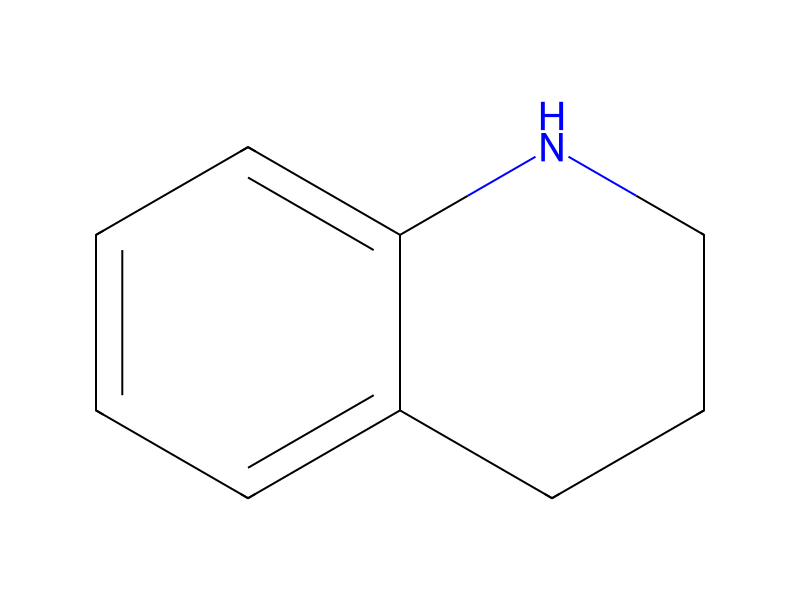
Product 1

Reagents, catalysts & solvents 1

Conditions
- Temperature
- 0 °C
Procedure
NBS (28 g, 158 mmol) was added to a solution of 1,2,3,4-tetrahydroquinoline (20 g, 150.16 mmol) in carbon tetrachloride (200 mL). The resulting solution was stirred for 3 h at 0° C., extracted with dichloromethane (3×50 mL) and concentrated in vacuo to give a residue, which was applied onto a silica gel column with 1% ethyl acetate in petroleum ether to give 6-bromo-1,2,3,4-tetrahydroquinoline as a yellow solid (11 g, 35%).
Workup
- extractionextracted with dichloromethane (3×50 mL)
- concentrationconcentrated in vacuo
- customto give a residue, which
Sources & evidence
- ORD record
- ord-73363feaa8f448679f88580056d01c35
- Source dataset
- uspto-grants-2015_07
- Patent number
- US09073902B2
Reaction notes
Loading…