1,4-Dioxane → HCID 178425143, compound
Reaction equation

Cl[C:2]1[CH:3]=[C:4]([C:14]([NH:16][CH2:17][C:18]2[C:19](=[O:26])[NH:20][C:21]([CH3:25])=[CH:22][C:23]=2[CH3:24])=[O:15])[C:5]2[CH:10]=[N:9][N:8]([CH:11]([CH3:13])[CH3:12])[C:6]=2[N:7]=1.[CH3:27][C:28]1[C:36]2[C:31](=[CH:32][CH:33]=[C:34](B3OC(C)(C)C(C)(C)O3)[CH:35]=2)[N:30](C(OC(C)(C)C)=O)[N:29]=1.P([O-])([O-])([O-])=O.[K+].[K+].[K+].O1CCOCC1>CCOC(C)=O.C1C=CC(P(C2C=CC=CC=2)[C-]2C=CC=C2)=CC=1.C1C=CC(P(C2C=CC=CC=2)[C-]2C=CC=C2)=CC=1.Cl[Pd]Cl.[Fe+2].C(Cl)Cl.O>[CH3:24][C:23]1[CH:22]=[C:21]([CH3:25])[NH:20][C:19](=[O:26])[C:18]=1[CH2:17][NH:16][C:14]([C:4]1[C:5]2[CH:10]=[N:9][N:8]([CH:11]([CH3:13])[CH3:12])[C:6]=2[N:7]=[C:2]([C:34]2[CH:35]=[C:36]3[C:31](=[CH:32][CH:33]=2)[NH:30][N:29]=[C:28]3[CH3:27])[CH:3]=1)=[O:15]Participants
Reactant 4
 HCID 312751,4-Dioxane
 HCID 62657Potassium Phosphate, Tribasic
 HCID 565974256-Chloro-N-[(4,6-dimethyl-2-oxo-1,2-dihydro-3-pyridinyl)methyl]-1-(1-methylethyl)-1H-pyrazolo[3,4-b]pyridine-4-carboxamide
 HCID 57415707tert-Butyl 3-methyl-5-(4,4,5,5-tetramethyl-1,3,2-dioxaborolan-2-yl)-1H-indazole-1-carboxylate
Product 1

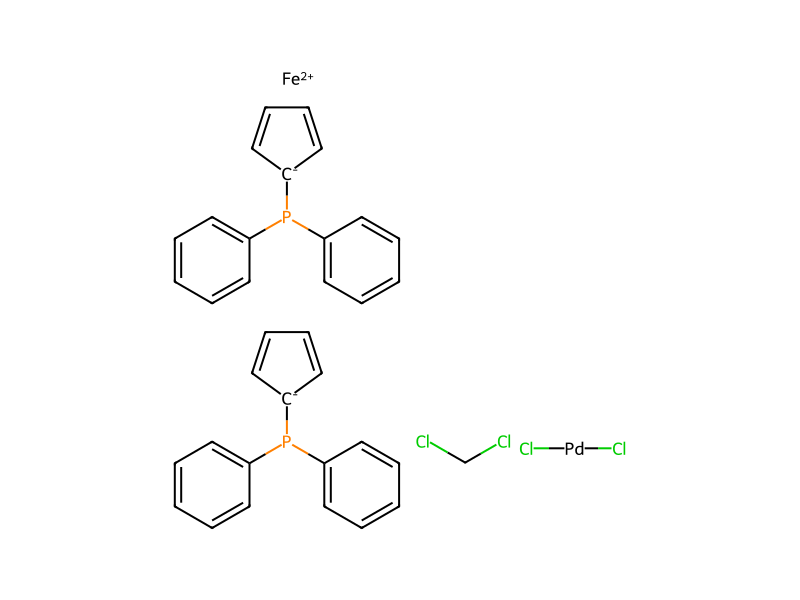
Reagents, catalysts & solvents 3


Conditions
- Temperature
- 105 °C
Procedure
To a 10 mL microwave vial were sequentially added 6-chloro-N-[(4,6-dimethyl-2-oxo-1,2-dihydro-3-pyridinyl)methyl]-1-(1-methylethyl)-1H-pyrazolo[3,4-b]pyridine-4-carboxamide (0.12 g, 0.321 mmol), 1,1-dimethylethyl 3-methyl-5-(4,4,5,5-tetramethyl-1,3,2-dioxaborolan-2-yl)-1H-indazole-1-carboxylate (0.138 g, 0.385 mmol), potassium phosphate (tribasic) (0.204 g, 0.963 mmol), 1,4-dioxane (3 mL), and water (0.75 mL). The stirring suspension was degassed with nitrogen for 10 min., wherein an emulsion had formed. Next added PdCl2(dppf)-CH2Cl2 adduct (0.039 g, 0.048 mmol) and the contents were placed onto a heat block and stirred at 105° C. overnight. After cooling to room temperature, the reaction mixture was diluted with EtOAc and filtered through Celite. The filter pad was washed with 50% THF/EtOAc. Silica gel was added to the combined filtrates and the mixture concentrated in vacuo to a solid. The contents were purified by silica gel chromatography (dry loaded, eluent: 5-80% gradient of DCM and chloroform containing 10% 2M Ammonia (in methanol)). The isolated solid was dried in vacuum oven at 45° C. overnight to afford the final product as 0.126 g (81%). LCMS E-S (M+H)=470.3. 1H NMR (400 MHz, DMSO-d6) δ ppm 1.56 (d, J=6.57 Hz, 6 H), 2.13 (s, 3 H), 2.25 (s, 3 H), 2.60 (s, 3 H), 4.43 (d, J=5.05 Hz, 2 H), 5.31-5.43 (m, 1 H), 5.91 (s, 1 H), 7.60 (d, J=8.84 Hz, 1 H), 8.22 (s, 1 H), 8.29-8.37 (m, 2 H), 8.60 (s, 1 H), 8.97 (t, J=5.05 Hz, 1 H), 11.58 (br. s., 1 H), 12.84 (s, 1 H).
Workup
- customThe stirring suspension was degassed with nitrogen for 10 min.
- customwherein an emulsion had formed
- temperatureAfter cooling to room temperature
- filtrationfiltered through Celite
- washThe filter pad was washed with 50% THF/EtOAc
- additionSilica gel was added to the combined filtrates
- concentrationthe mixture concentrated in vacuo to a solid
- customThe contents were purified by silica gel chromatography (dry loaded, eluent: 5-80% gradient of DCM and chloroform containing 10% 2M Ammonia (in methanol))
- customThe isolated solid was dried in vacuum oven at 45° C. overnight
Sources & evidence
- ORD record
- ord-a9e9d61abb6c45368e9ffd4dbf52d1da
- Source dataset
- uspto-grants-2015_07
- Patent number
- US09073924B2
Reaction notes
Loading…