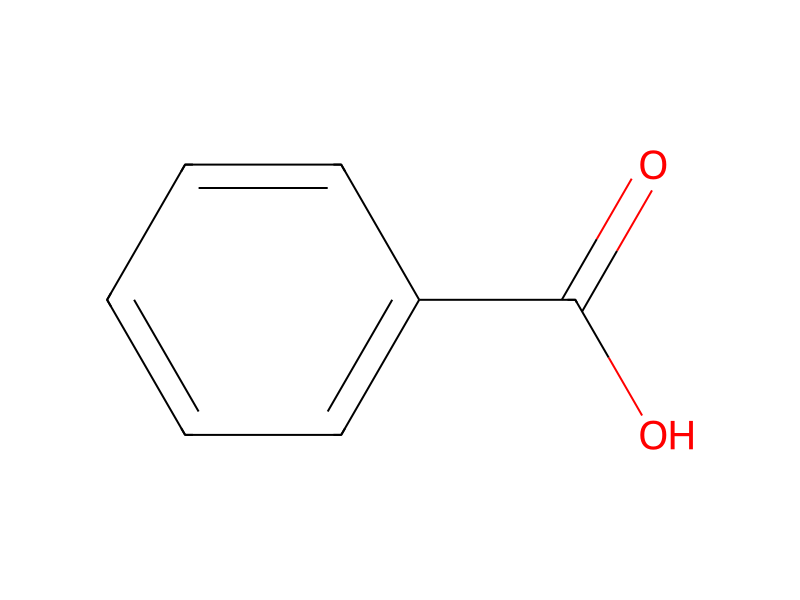
Benzoic Acid → HCID 86731807, compound
Reaction equation

[CH3:1][CH:2]([CH2:5][CH2:6][C@H:7]1[CH2:11][CH:10]=[C:9]([CH3:12])[C:8]1([CH3:14])[CH3:13])[CH:3]=[O:4].C(O)(=O)C1C=CC=CC=1>>[CH3:1][CH:2]([CH2:5][CH2:6][C@H:7]1[CH2:11][CH:10]=[C:9]([CH3:12])[C:8]1([CH3:13])[CH3:14])[CH2:3][OH:4]Participants


Conditions
- Temperature
- 100 °C
Procedure
2-methyl-4-((S)-2,2,3-trimethylcyclopent-3-en-1-yl)butanal (as a 50/50 diastereoisomers mixture) (388 g, 2 mol.), benzoic acid (2.44 g, 0.02 mol., 1 mol.%) and (ethylenediamine) [1,2-bis(diphenylphosphino)ethane]ruthenium(bispivalate) (30.5 mg, 0.04 mmol, 0.002 mol.%) were loaded altogether in a 1 L autoclave equipped with a mechanical stirring device. Sealed autoclave was then purged under stirring with nitrogen (3 times 5 bars) and hydrogen (3 times 5 bars) before being pressurized to 50 bars hydrogen. It was then heated to 100° C. and hydrogen pressure was maintained to 50 bars during all the reaction to afford desired product with more than 99.0% selectivity as a 50/50 diastereoisomers mixture and no loss of optical purity. Upon complete reaction conversion (checked by both hydrogen consumption and GC), autoclave was cooled down to 25° C. It was then depressurized and purged with nitrogen (3 times 5 bars). After flash distillation, 2-methyl-4-((S)-2,2,3-trimethylcyclopent-3-en-1-yl)butan-1-ol was obtained in more than 98.0% yield.
Workup
- customequipped with a mechanical stirring device
- customSealed autoclave
- customwas then purged
- temperaturehydrogen pressure was maintained to 50 bars during all
- customthe reaction
Sources & evidence
- ORD record
- ord-212b53a356094a448a68292ebf245e41
- Source dataset
- uspto-grants-2015_07
- Patent number
- US09090534B2
Reaction notes
Loading…