Acetic Acid → HCID 57875744, compound
Reaction equation

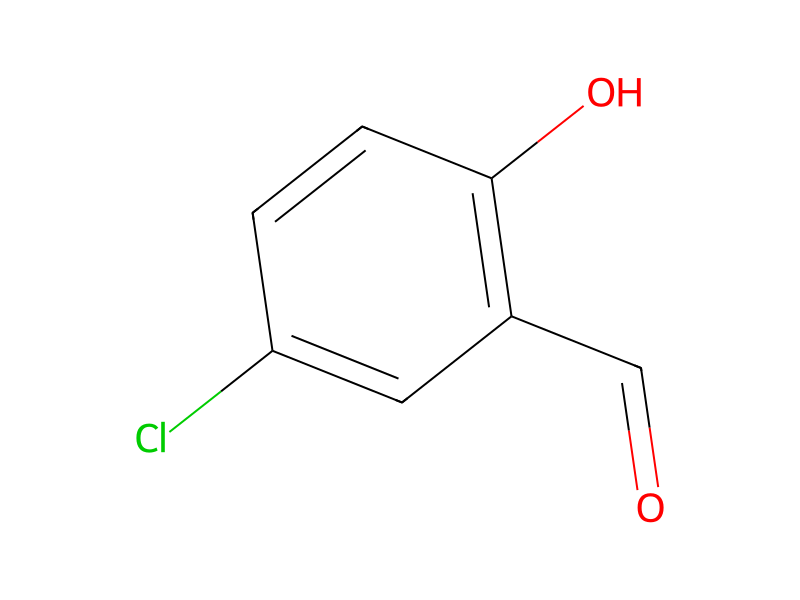
[Cl:1][C:2]1[CH:3]=[CH:4][C:5]([OH:10])=[C:6]([CH:9]=1)[CH:7]=O.[C:11]([O:15][C:16](=[O:19])[NH:17][NH2:18])([CH3:14])([CH3:13])[CH3:12].C(O)(=O)C.C(O[BH-](OC(=O)C)OC(=O)C)(=O)C.[Na+]>C(Cl)Cl>[C:11]([O:15][C:16]([NH:17][NH:18][CH2:7][C:6]1[CH:9]=[C:2]([Cl:1])[CH:3]=[CH:4][C:5]=1[OH:10])=[O:19])([CH3:14])([CH3:13])[CH3:12]Participants
6
Reactant 4



Product 1

Reagents, catalysts & solvents 1

Procedure
A solution of 5-chloro-2-hydroxybenzaldehyde (1.5 g 9.3 mmol), tert-butylcarbazate (1.25 g, 9.3 mmol) and acetic acid (0.54 mL, 9.3 mmol) in CH2Cl2 (50 mL) was stirred under a nitrogen atmosphere for 30 min at RT. Then sodium triacetoxyborohydride (6.20 g, 27.9 mmol) was added portion wise and the resulting mixture was stirred at RT overnight. The reaction was thoroughly quenched with 2 M HCl (15 mL) and stirred at RT for 1 h. The reaction mixture was partitioned between water (50 mL) and CH2Cl2 (25 mL). The aqueous layer was extracted with CH2Cl2 (25 mL). The combined organic layers were washed with water (2×75 mL), dried (Na2SO4) and evaporated to dryness to give hydrazine 1 as a white solid.
Workup
- customThe reaction was thoroughly quenched with 2 M HCl (15 mL)
- stirringstirred at RT for 1 h
- customThe reaction mixture was partitioned between water (50 mL) and CH2Cl2 (25 mL)
- extractionThe aqueous layer was extracted with CH2Cl2 (25 mL)
- washThe combined organic layers were washed with water (2×75 mL)
- dry with materialdried (Na2SO4)
- customevaporated to dryness
Sources & evidence
- ORD record
- ord-f92a0f5afe9b47629299b28ebef66b53
- Source dataset
- uspto-grants-2015_07
- Patent number
- US09090566B2
Reaction notes
Loading…