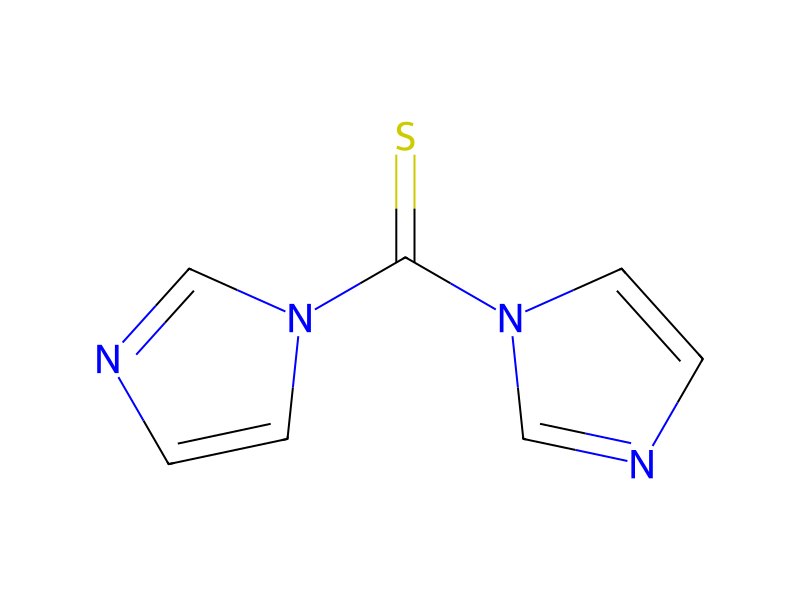
1,1'-Thiocarbonyldiimidazole → tert-Butyl 4-carbamothioylpiperazine-1-carboxylate
Reaction equation

[C:1](N1C=CN=C1)([N:3]1C=CN=C1)=[S:2].[N:13]1([C:19]([O:21][C:22]([CH3:25])([CH3:24])[CH3:23])=[O:20])[CH2:18][CH2:17][NH:16][CH2:15][CH2:14]1>O1CCCC1>[NH2:3][C:1](=[S:2])[N:16]1[CH2:17][CH2:18][N:13]([C:19]([O:21][C:22]([CH3:25])([CH3:24])[CH3:23])=[O:20])[CH2:14][CH2:15]1Participants
Reactant 2

Product 1

Reagents, catalysts & solvents 1

Procedure
To a solution of thiocarbonyldiimidazole (2.1 g, 11.8 mmol) in tetrahydrofuran (30 mL) at room temperature, was added 1,1-dimethylethyl 1-piperazinecarboxylate (2 g, 10.75 mmol). The reaction mixture was stirred at room temperature for 2 h and then heated to 55° C. for additional 2 h. The reaction mixture was cooled to room temperature, and concentrated under reduced pressure until approximately 20 mL of tetrahydrofuran remained. The residue was then treated with a 2 M solution of ammonia in methanol (10 mL) and stirred at room temperature for 24 h. The reaction mixture was concentrated under reduced pressure, and the residue was triturated with diethyl ether (25 mL) to give a white precipitate. The precipitate was filtered and dried to give 1.5 g of the title compound as a white solid.
Workup
- temperatureheated to 55° C. for additional 2 h
- temperatureThe reaction mixture was cooled to room temperature
- concentrationconcentrated under reduced pressure until approximately 20 mL of tetrahydrofuran
- additionThe residue was then treated with a 2 M solution of ammonia in methanol (10 mL)
- stirringstirred at room temperature for 24 h
- concentrationThe reaction mixture was concentrated under reduced pressure
- customthe residue was triturated with diethyl ether (25 mL)
- customto give a white precipitate
- filtrationThe precipitate was filtered
- customdried
Sources & evidence
- ORD record
- ord-65ad98589f2b4f17a8def9603ec0fb3d
- Source dataset
- uspto-grants-2015_07
- Patent number
- US09090604B2
Reaction notes
Loading…