2,4,4-Trimethyl-1-pentene → N-octyl-N-phenylaniline
Reaction equation

[C:1]1([NH:7][C:8]2[CH:13]=[CH:12][CH:11]=[CH:10][CH:9]=2)[CH:6]=[CH:5][CH:4]=[CH:3][CH:2]=1.C[C:15]([CH2:17][C:18]([CH3:21])(C)C)=[CH2:16].[CH3:22][C:23](=C)[CH3:24]>>[CH2:22]([N:7]([C:1]1[CH:2]=[CH:3][CH:4]=[CH:5][CH:6]=1)[C:8]1[CH:9]=[CH:10][CH:11]=[CH:12][CH:13]=1)[CH2:23][CH2:24][CH2:21][CH2:18][CH2:17][CH2:15][CH3:16]Participants


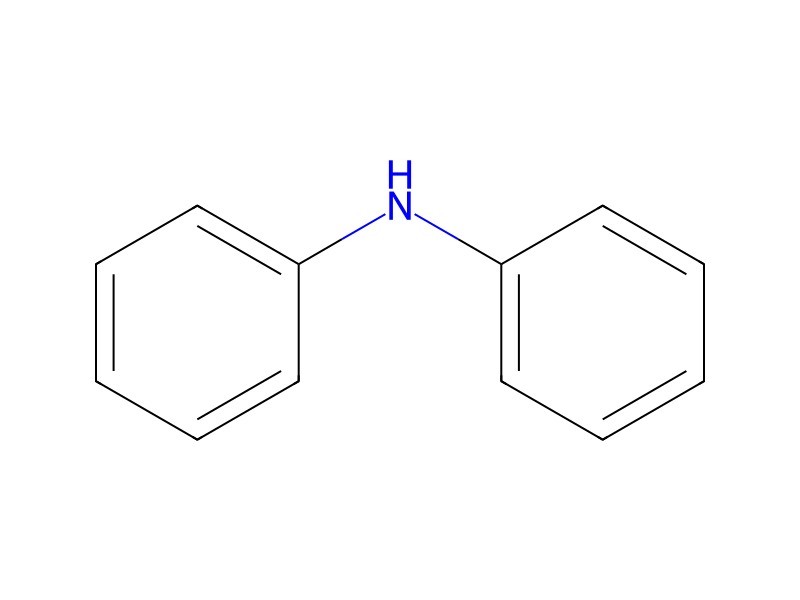

Conditions
- Temperature
- 160 °C
Procedure
In a 50 gallon (about 189 L) reactor, 144 pounds (about 65.5 kg) of diphenylamine and 5.9 pounds (about 2.7 kg) of Filtrol™ clay (Engelhard Corp., Iselin, N.J.) were mixed in a reactor and heated to 160° C. for 20 minutes to drive off moisture. About 124.3 pounds (about 56.5 kg) of diisobutylene at room temperature was then added to the reactor over the period of one minute or less. The reaction temperature dropped and then climbed back to an initial set point temperature of 160° C. Within about 10 minutes of first adding the diisobutylene, 28.7 pounds (about 13 kg) of isobutylene was charged in the reactor over a period of about 30 minutes such that the pressure was kept below about 90 psi (about 6.2×10⁵ Pa). Based on experience and Examples illustrated in U.S. Pat. No. 5,750,787, it is believed that the initiation of the addition of isobutylene occurred before the reactive composition of diisobutylene and diphenylamine formed at least 50 wt. % monooctyldiphenylamine.
Workup
- additionThe reaction temperature dropped
- customset point temperature of 160° C
- additionwas charged in the reactor over a period of about 30 minutes such that the pressure
Sources & evidence
- ORD record
- ord-63fcf16503dc4c21888c3fe81c318600
- Source dataset
- uspto-grants-2001_03
- Patent number
- US06204412B1
Reaction notes
Loading…