Benzene → 1-ethyl-2-propylbenzene
Reaction equation

[CH2:1]=[CH2:2].[CH2:3]=[CH:4][CH3:5].[CH:6]1[CH:11]=[CH:10][CH:9]=[CH:8][CH:7]=1.[C:12]1([CH3:18])[CH:17]=[CH:16][CH:15]=[CH:14][CH:13]=1>C1(C)C(C)=CC=CC=1>[CH2:4]([C:5]1[C:10]([CH2:9][CH2:8][CH3:7])=[C:11]([CH3:6])[CH:13]=[CH:12][CH:17]=1)[CH3:3].[CH2:1]([C:13]1[CH:14]=[CH:15][CH:16]=[CH:17][C:12]=1[CH2:18][CH2:3][CH3:4])[CH3:2]Participants
Reactant 4



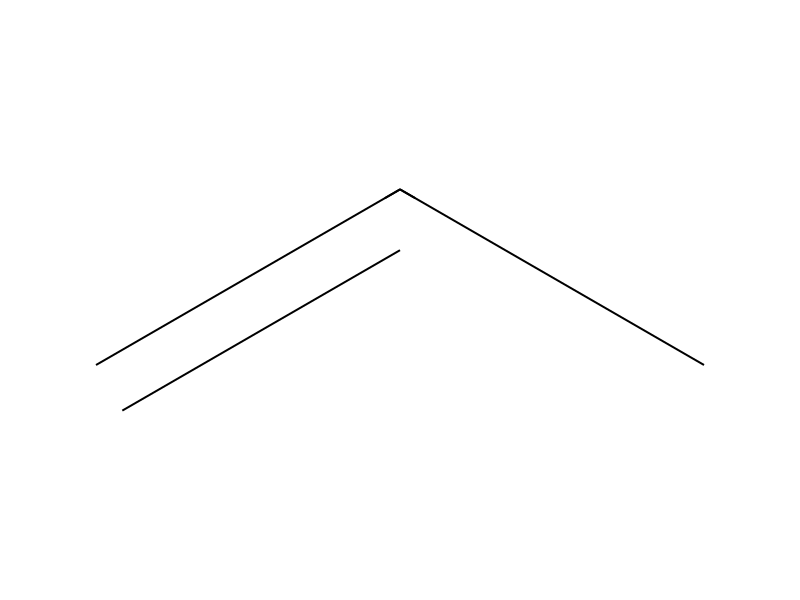
Product 2


Reagents, catalysts & solvents 1

Procedure
In a preferred process, the process of the present invention can be run as follows. A gaseous hydrocarbon-containing olefin stream 27 comprising ethylene and propylene is fed into the reactor 1 at inlet port 22 located at the lower end 36 of vessel 2. A liquid hydrocarbon-containing aromatic stream 23 comprising benzene, toluene, and xylene is fed into the reactor 1 at inlet port 26 located at the upper end 38 of vessel 2. The ratio of aromatic to olefin in the reactor 1 is about 4:1 to 15:1. Operating conditions present in the reactor 1 include a temperature of about 300-450 deg F, a pressure of about 1-30 atm, and a weight hourly space velocity of about 0.1-20 hr-1. The aromatic and olefinic hydrocarbons flow into the distillation zone 21 of the vessel 2 which is filled with a liquid-containing aromatic. From the distillation zone 21, the aromatic and olefinic hydrocarbons flow radially through the openings 32 into the tubes 30. Once inside the tubes 30, the aromatic and olefinic hydrocarbons react in the presence of continuously moving catalyst particles comprising beta zeolite in an alumina matrix to form alkyl-substituted aromatic comprising ethyl- and propylbenzene, ethyl- and propyltoluene, ethylpropyltoluene, and ethylpropylbenzene. These alkyl-substituted aromatics flow radially out of the tubes 30 into the distillation zone 21 of the vessel 2 where there are immediately separated from unreacted aromatics and olefinic hydrocarbons by distillation. To assist in distillation, the distillation zone 21 is filled with Berl saddles. An overhead stream 40 comprising unreacted ethylene, propylene, benzene, toluene, and xylene exits the reactor at port 24. This overhead stream 40 is fed to an overhead condenser 54. The effluent from the condenser 54 is fed to a separator drum 42. Noncondensable gases, such as unreacted ethylene and propylene, exit the top of the separator drum 42 in stream 43. Light liquid products, including benzene, toluene, and xylene, exit the bottom of the separator drum 42 in stream 45. A substantial portion of the light liquid product stream 45 is refluxed to the upper end 38 of the vessel 2. The remainder of the light liquid product 45 is recovered as product. A bottoms stream 44 comprising ethyl- and propylbenzene, ethyl- and propyltoluene, ethylpropyltoluene, and ethylpropylbenzene exits the distillation 21 at the bottoms port 28. A portion of the bottoms stream 44 is fed to a reboiler 34 and recycled back to the lower end 36 of the vessel 2.
Workup
- customis fed into the reactor 1 at inlet
- customport 22 located at the lower end 36 of vessel
- customis fed into the reactor 1 at inlet
- customport 26 located at the upper end 38 of vessel
- customa temperature of about 300-450 deg F
- customa weight hourly space velocity of about 0.1-20 hr
- additionis filled with a liquid-containing aromatic
Sources & evidence
- ORD record
- ord-c65706b92c394a06b5b30d7022bbe44e
- Source dataset
- uspto-grants-1992_02
- Patent number
- US05087784
Reaction notes
Loading…