Hydrochloric Acid → Prostaglandin B2
Reaction equation
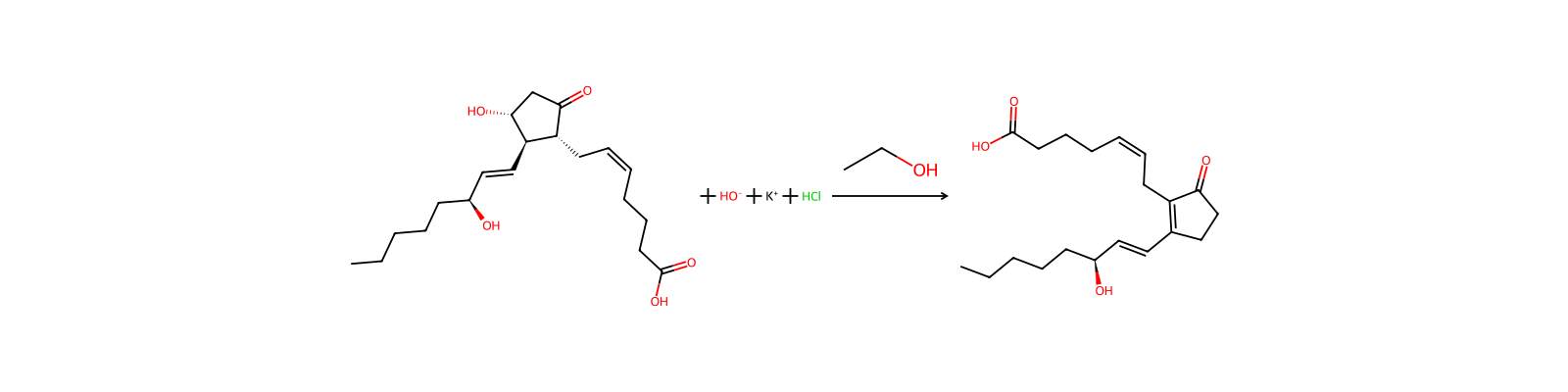
[CH3:1][CH2:2][CH2:3][CH2:4][CH2:5][C@H:6]([OH:25])/[CH:7]=[CH:8]/[C@@H:9]1[C@@H:14]([CH2:15]/[CH:16]=[CH:17]\[CH2:18][CH2:19][CH2:20][C:21]([OH:23])=[O:22])[C:12](=[O:13])[CH2:11][C@H:10]1O.[OH-].[K+].Cl>C(O)C>[CH3:1][CH2:2][CH2:3][CH2:4][CH2:5][C@H:6]([OH:25])/[CH:7]=[CH:8]/[C:9]1[CH2:10][CH2:11][C:12](=[O:13])[C:14]=1[CH2:15]/[CH:16]=[CH:17]\[CH2:18][CH2:19][CH2:20][C:21]([OH:23])=[O:22]Participants
5
Reactant 3



Product 1

Reagents, catalysts & solvents 1

Conditions
- Temperature
- 10 °C
Procedure
A solution of racemic PGE2 (200 mg.) in 100 ml. of 50% aqueous ethanol containing 10 grams of potassium hydroxide is kept at 25° C. for 10 hours under nitrogen. Then, the solution is cooled to 10° C. and neutralized by addition of 3 normal hydrochloric acid at 10° C. The resulting solution is extracted repeatedly with ethyl acetate, and the combined ethyl acetate extracts are washed with water and then with saturated aqueous sodium chloride solution, dried, and evaporated to give racemic PGB2.
Workup
- extractionThe resulting solution is extracted repeatedly with ethyl acetate
- washthe combined ethyl acetate extracts are washed with water
- dry with materialwith saturated aqueous sodium chloride solution, dried
- customevaporated
Sources & evidence
- ORD record
- ord-906e8ada8d03497584ab87be25f32e53
- Source dataset
- uspto-grants-1976_09
- Patent number
- US03983153
Reaction notes
Loading…