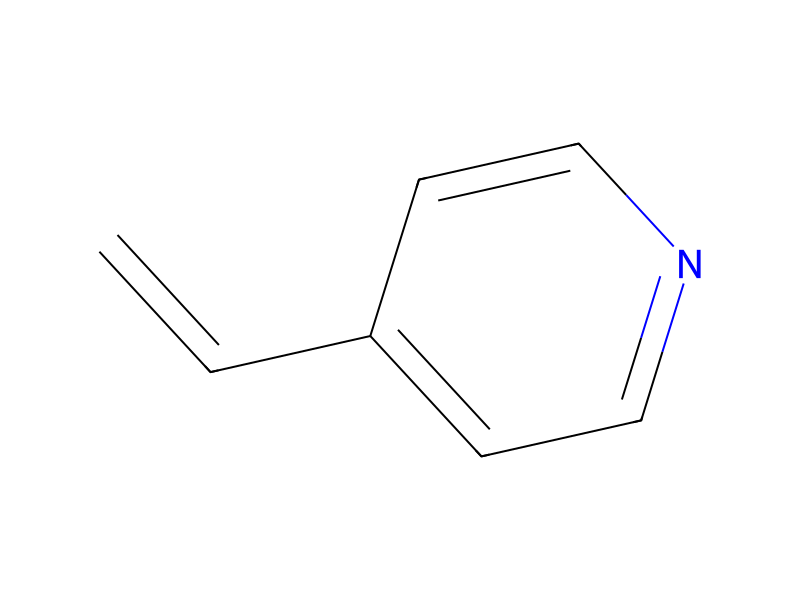
Sodium Chloride → 4-vinylpyridine N,N'-methylenebisacrylamide
Reaction equation

[Cl-].[Na+].[CH:3]([C:5]1[CH:10]=[CH:9][N:8]=[CH:7][CH:6]=1)=[CH2:4].[CH2:11]([NH:17][C:18](=[O:21])[CH:19]=[CH2:20])[NH:12][C:13](=[O:16])[CH:14]=[CH2:15].N(C(C)(C)C#N)=NC(C)(C)C#N>C(C(CC(C)C)=O)C(C)C.O>[CH:3]([C:5]1[CH:10]=[CH:9][N:8]=[CH:7][CH:6]=1)=[CH2:4].[CH2:11]([NH:12][C:13](=[O:16])[CH:14]=[CH2:15])[NH:17][C:18](=[O:21])[CH:19]=[CH2:20]Participants
7






Procedure
To a one-liter, 3-neck round bottom flask equipped with a heating mantle, nitrogen bubbler, stirrer, thermometer and reflux condenser were added 200 ml of deionized water and 75 g of sodium chloride. The solution was stirred under nitrogen for 30 minutes at room temperature and a solution of 30.0 g of 4-vinylpyridine, 3.0 g of N,N'-methylenebisacrylamide and 0.2 g of azobisisobutyronitrile in 90 ml of diisobutylketone was added. The temperature of the reaction solution was increased to between about 65° C. and about 70° C. with rapid stirring (200 rpm). After about 30 minutes some precipitate formed.
Workup
- customTo a one-liter, 3-neck round bottom flask equipped with a heating mantle, nitrogen bubbler, stirrer
- temperaturethermometer and reflux condenser
- temperatureThe temperature of the reaction solution was increased to between about 65° C. and about 70° C.
- stirringwith rapid stirring (200 rpm)
- customAfter about 30 minutes some precipitate formed
Sources & evidence
- ORD record
- ord-2635ac0fa699409cb8bdd833e453106e
- Source dataset
- uspto-grants-1981_09
- Patent number
- US04289695
Reaction notes
Loading…