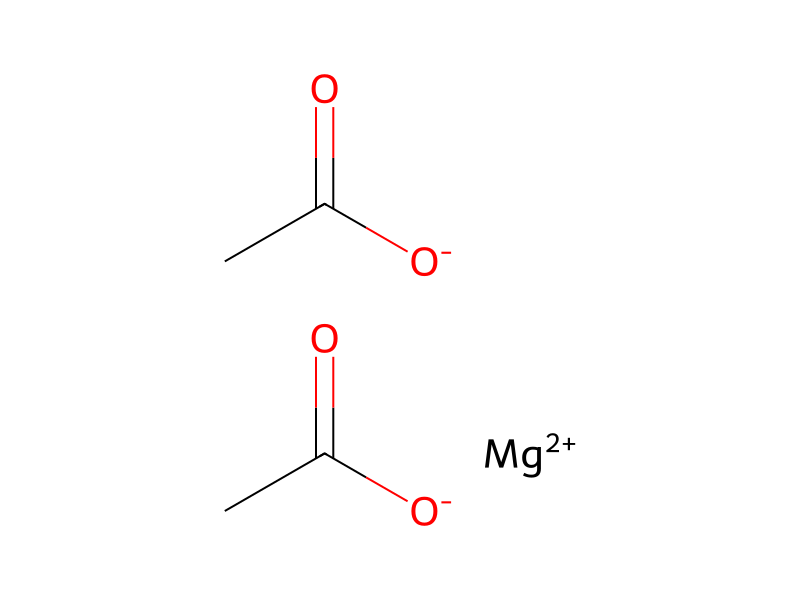
Magnesium Acetate → Magnesium Acetate Tetrahydrate
Reaction equation

[C:1]([O-:4])(=[O:3])[CH3:2].[Mg+2:5].[C:6]([O-:9])(=[O:8])[CH3:7]>O>[OH2:3].[OH2:8].[OH2:3].[OH2:3].[C:1]([O-:4])(=[O:3])[CH3:2].[Mg+2:5].[C:6]([O-:9])(=[O:8])[CH3:7].[O-2:3].[Mg+2:5]Participants
Reactant 1
Product 2


Reagents, catalysts & solvents 1

Procedure
An aqueous solution of magnesium acetate tetrahydrate was prepared by adding one part by weight of the magnesium acetate compound to five parts by weight of water. A glassware article (bottle) was heated to provide a surface temperature of about 640° C. The solution of magnesium acetate was sprayed at a flow rate of about 0.5 grams per second while the glassware was rotated upon a turntable at 78 rpm. Approximately 16 revolutions of the glassware bottle occurred during an application. A clear, transparent coating of magnesium oxide was formed on the bottle. Thereafter, when the glassware had cooled to 120° C., a commercial "cold end" coating, i.e., GLAS-LUBE 1000 available from Crown Chemical Company, diluted by a factor of 100 by weight in distilled water was sprayed at the rate of 1 gram of "cold end" coating solution per second for a period of 5 revolutions of the glassware on the turntable as discussed above. The thus coated article with both "hot end" and "cold end" coatings was tested for lubrication both wet and dry. Under both conditions lubrication was found to be excellent when two such glassware articles were manually rubbed together.
Workup
- temperatureA glassware article (bottle) was heated
- customto provide a surface temperature of about 640° C
Sources & evidence
- ORD record
- ord-a9a5533de78a4184a584d675f462ea1c
- Source dataset
- uspto-grants-1981_09
- Patent number
- US04289816
Reaction notes
Loading…