Ethylene → Dicyclopentadiene
Reaction equation

ClCl.[CH2:3]=[CH2:4].[CH2:5]=[CH:6][CH3:7]>O>[CH2:6]1[CH:7]2[CH:4]3[CH:3]=[CH:5][CH:6]([CH:4]2[CH:3]=[CH:5]1)[CH2:7]3Participants
Reactant 3

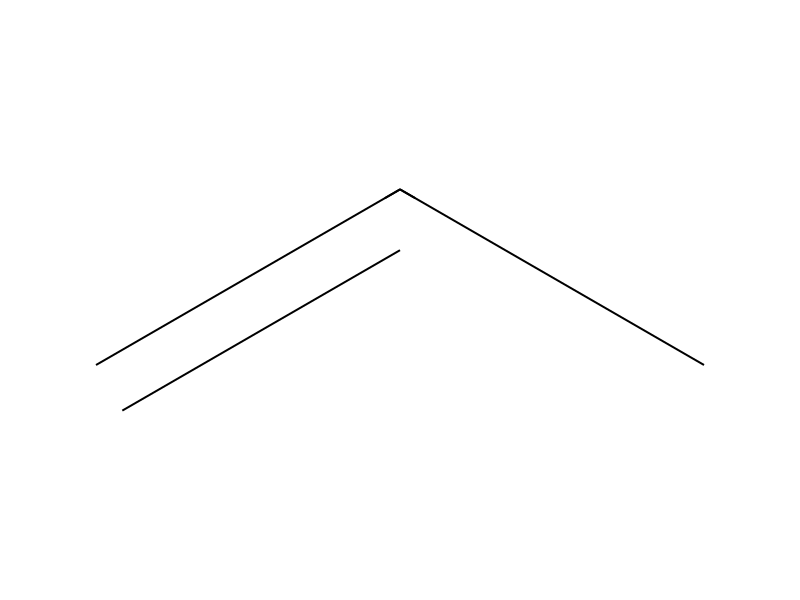

Product 1

Reagents, catalysts & solvents 1

Procedure
4 liters of chlorine gas (20°C, 1 atmosphere) were passed during a period of 30 minutes at 25°C in diffuse daylight through a dispersion of 35 g of a terpolymer in 1 liter of water. The terpolymer was composed of 53.9% by weight of ethylene, 42% by weight of propylene, and 4.1% by weight of 5-ethylidenenorbornene-2. The dispersed terpolymer particles ranged in size from 3 -22 mm. The dispersion was intensively stirred during the passage of the chlorine gas. After the passage of the chlorine gas was complete, the dispersion was ventilated and pure nitrogen gas was passed through the dispersion to remove any excess chlorine. The chlorinated terpolymer was recovered by filtration, and the resulting rubbery crumb was washed with distilled water and dried. The resulting terpolymer contained 3.3% by weight of chlorine. According to the N.M.R. analysis the copolymer thus prepared contained no allylic bounded chlorine.
Workup
- customto remove any excess chlorine
- filtrationThe chlorinated terpolymer was recovered by filtration
- washthe resulting rubbery crumb was washed with distilled water
- customdried
- customanalysis the copolymer thus prepared
Sources & evidence
- ORD record
- ord-cae686ee4ca646cb9177fdd163af9e36
- Source dataset
- uspto-grants-1976_02
- Patent number
- US03936430
Reaction notes
Loading…