Benzaldehyde → HCID 134806, compound
Reaction equation

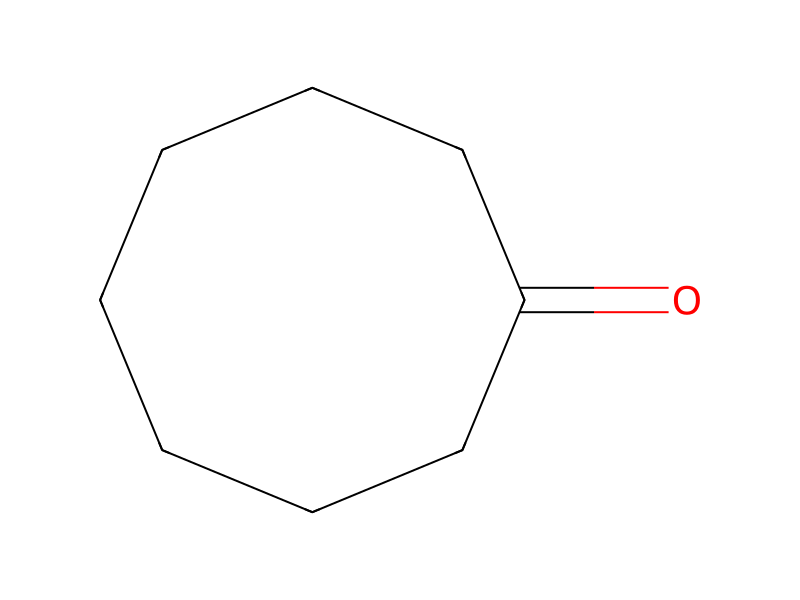
[C:1]1(=[O:9])[CH2:8][CH2:7][CH2:6][CH2:5][CH2:4][CH2:3][CH2:2]1.[CH:10](=O)[C:11]1[CH:16]=[CH:15][CH:14]=[CH:13][CH:12]=1.[OH-].[K+].CO>C(O)(C)(C)C>[CH:10](=[C:2]1[CH2:3][CH2:4][CH2:5][CH2:6][CH2:7][C:8](=[CH:10][C:11]2[CH:16]=[CH:15][CH:14]=[CH:13][CH:12]=2)[C:1]1=[O:9])[C:11]1[CH:16]=[CH:15][CH:14]=[CH:13][CH:12]=1Participants
Reactant 4



Product 1

Reagents, catalysts & solvents 1

Procedure
An alternative procedure for preparing 2,8-dibenzylcyclooctanones involves the corresponding 2,8-dibenzylidenecyclooctanones as the intermediates. Thus, a mixture comprising 12.5 grams of cyclooctanone, 27 grams of benzaldehyde, 15 grams of potassium hydroxide and 300 milliliters of methanol is stirred at reflux temperatures for 4 hours. To the hot, stirred mixture are slowly added 400 milliliters of t-butyl alcohol with simultaneous removal of the methanol by distillation. The mixture is then cooled, water is added and the product is extracted with ether. The crude product obtained from the ether extract is chromatographed on activated alumina to give 2,8-dibenzylidenecyclooctanone. This intermediate is hydrogenated at 60 p.s.i.g. in ethanol using 5 percent palladium on carbon. Fractional crystallization of the hydrogenation product from methanol affords the isomeric 2,8-dibenzylcyclooctanones, m.p. 75°-77° C. and 66°-68° C.
Workup
- temperatureat reflux temperatures for 4 hours
- stirringTo the hot, stirred mixture
- customwith simultaneous removal of the methanol
- distillationby distillation
- temperatureThe mixture is then cooled
- additionwater is added
- extractionthe product is extracted with ether
- customThe crude product obtained from the ether
- extractionextract
- customis chromatographed on activated alumina
Sources & evidence
- ORD record
- ord-fed9ac6d19b5408d8df4df33941dbab0
- Source dataset
- uspto-grants-1976_02
- Patent number
- US03937710
Reaction notes
Loading…