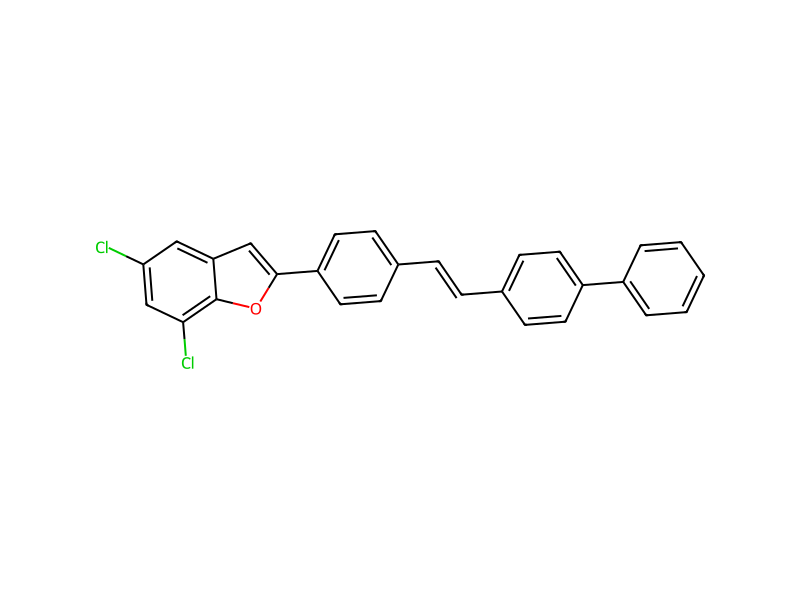
51357-73-4 → 2-{4-[2-([1,1'-Biphenyl]-4-yl)ethenyl]phenyl}-5,7-dichloro-1-benzofuran
Reaction equation

[Cl:1][C:2]1[CH:3]=[C:4]([Cl:18])[C:5]2[O:9][C:8]([C:10]3[CH:15]=[CH:14][C:13]([CH3:16])=[CH:12][CH:11]=3)=[CH:7][C:6]=2[CH:17]=1.[C:19]1([C:25]2[CH:38]=[CH:37][C:28]([CH:29]=NC3C=CC=CC=3)=[CH:27][CH:26]=2)[CH:24]=[CH:23][CH:22]=[CH:21][CH:20]=1.CC(C)([O-])C.[K+]>>[Cl:1][C:2]1[CH:3]=[C:4]([Cl:18])[C:5]2[O:9][C:8]([C:10]3[CH:11]=[CH:12][C:13]([CH:16]=[CH:29][C:28]4[CH:37]=[CH:38][C:25]([C:19]5[CH:20]=[CH:21][CH:22]=[CH:23][CH:24]=5)=[CH:26][CH:27]=4)=[CH:14][CH:15]=3)=[CH:7][C:6]=2[CH:17]=1Participants
4



Procedure
Following the procedure given in Example 1b equimolar quantities of the above named 5,7-dichloro-2-(p-tolyl)benzofuran and 4-phenylbenzalaniline were interacted in the presence of potassium tert.-butoxide to give 5,7-dichloro2-{4-[2-(4-biphenylyl)vinyl]phenyl}benzofuran which, following recrystallization from chlorobenzene, melted at 258°-260° C. The wavelength of maximum excitation of this compound was 375 nm., and the wavelength of maximum emission was 431 nm.
Sources & evidence
- ORD record
- ord-6d3c01cde329492b82966f7d9c04f748
- Source dataset
- uspto-grants-1976_01
- Patent number
- US03932301
Reaction notes
Loading…