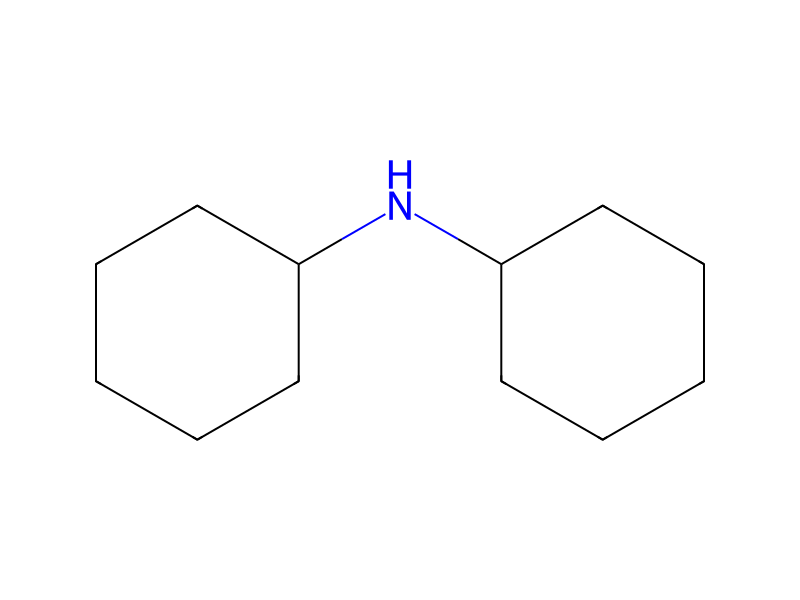
Cephalosporin C → Dicyclohexylamine
Reaction equation

Cl.[CH:2]1([NH:8][CH:9]2[CH2:14][CH2:13][CH2:12][CH2:11][CH2:10]2)[CH2:7][CH2:6][CH2:5][CH2:4][CH2:3]1.CC(OCC1CS[C@@H]2[C@H](NC(CCC[C@@H](N)C(O)=O)=O)C(=O)N2C=1C(O)=O)=O>O>[CH:9]1([NH:8][CH:2]2[CH2:3][CH2:4][CH2:5][CH2:6][CH2:7]2)[CH2:10][CH2:11][CH2:12][CH2:13][CH2:14]1Participants
4
Reactant 2


Product 1
Reagents, catalysts & solvents 1

Procedure
Concentration in vacuo or at atmospheric pressure of the mother liquors leaves a post residue consisting of essentially dicyclohexylamine hydrochloride, water and unreacted or decomposed cephalosporin C by-products. Basification of the pH to about 9 with sodium hydroxide, followed by physical separation of the two layers produces essentially pure dicyclohexylamine in about 85-95% recofery of theory.
Workup
- concentrationConcentration in vacuo
- customat atmospheric pressure of the mother liquors leaves a post residue
- customBasification of the pH to about 9 with sodium hydroxide, followed by physical separation of the two layers
Sources & evidence
- ORD record
- ord-90794c0d985d491c86f822f988913617
- Source dataset
- uspto-grants-1976_01
- Patent number
- US03932392
Reaction notes
Loading…