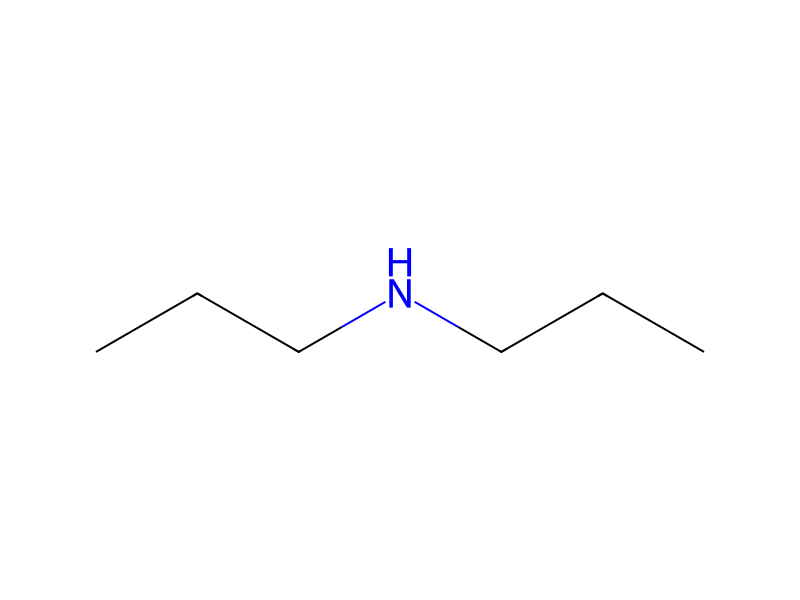
Dipropylamine → HCID 178457187, compound
Reaction equation

[Cl:1][C:2]1[CH:20]=[CH:19][C:5]2[N:6]=[C:7]([CH2:17]Cl)[NH:8][SH:9](=[O:16])([C:10]3[CH:15]=[CH:14][CH:13]=[CH:12][CH:11]=3)[C:4]=2[CH:3]=1.[CH2:21]([NH:24][CH2:25][CH2:26][CH3:27])[CH2:22][CH3:23]>CO>[Cl:1][C:2]1[CH:20]=[CH:19][C:5]2[N:6]=[C:7]([CH2:17][N:24]([CH2:25][CH2:26][CH3:27])[CH2:21][CH2:22][CH3:23])[NH:8][SH:9](=[O:16])([C:10]3[CH:15]=[CH:14][CH:13]=[CH:12][CH:11]=3)[C:4]=2[CH:3]=1Participants
4
Reactant 2

Product 1

Reagents, catalysts & solvents 1

Procedure
5g 7-chloro-3-chloromethyl-1-phenyl-benzo-1,2,4-thiadiazine-1-oxide and 20 g di-n-propylamine are dissolved in 80 ml methanol and left standing for 12 hours at room temperature. Thereafter the solution is evaporated and the residue distributed between chloroform and water. The chloroform phase is extracted with water several times, dried, evaporated, and the base (oil) dissolved in ethanol. After addition of ethanolic hydrochloric acid, the dihydrochloride precipitates. M.p. 192°-195° (decompn.).
Workup
- waitleft
- customThereafter the solution is evaporated
- extractionThe chloroform phase is extracted with water several times
- customdried
- customevaporated
- dissolutionthe base (oil) dissolved in ethanol
- additionAfter addition of ethanolic hydrochloric acid
- customthe dihydrochloride precipitates
Sources & evidence
- ORD record
- ord-93ea1b543ee84bc8bbf2053eb2c2ed9c
- Source dataset
- uspto-grants-1976_01
- Patent number
- US03933805
Reaction notes
Loading…