Cyclopentylamine → 2-chloro-3-(cyclopentylamino)naphthalene-1,4-dione
Reaction equation

[CH:1]1([NH2:6])[CH2:5][CH2:4][CH2:3][CH2:2]1.[Cl:7][C:8]1[C:9](=[O:20])[C:10]2[C:15]([C:16](=[O:19])[C:17]=1Cl)=[CH:14][CH:13]=[CH:12][CH:11]=2>C(O)C>[CH:1]1([NH:6][C:17]2[C:16](=[O:19])[C:15]3[C:10]([C:9](=[O:20])[C:8]=2[Cl:7])=[CH:11][CH:12]=[CH:13][CH:14]=3)[CH2:5][CH2:4][CH2:3][CH2:2]1Participants
Reactant 2

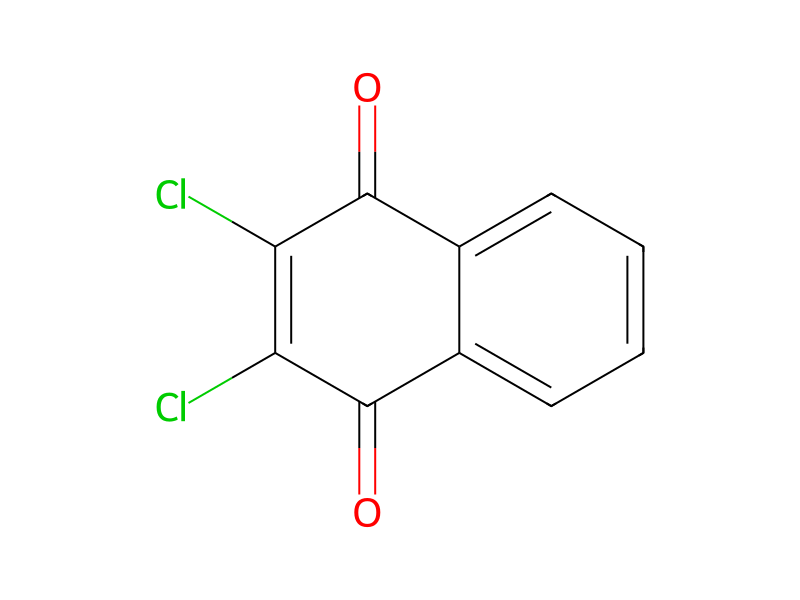
Product 1

Reagents, catalysts & solvents 1

Procedure
18.7 G. of cyclopentylamine in 50 ml. of absolute ethanol are added dropwise while stirring at room temperature to a suspension of 22.7 g. of 2,3-dichloro-1,4-naphthoquinone in 100 ml. of absolute ethanol. After the addition, the mixture is boiled under reflux for 1 hour. The resulting dark-red mixture is then evaporated under reduced pressure. The residue is then dissolved in 600 ml. of chloroform and shaken out successively with 200 ml. of water, three times with 100 ml. of 3-N hydrochloric acid each time and three times with 100 ml. of water each time. After drying over sodium sulfate, the chloroform solution is concentrated, treated with active carbon and evaporated. After crystallization from n-hexane, 23.9 g. of 2-cyclopentylamino-3-chloro-1,4-naphthoquinone of melting point 81°-83°C. are obtained.
Workup
- additionAfter the addition
- temperatureunder reflux for 1 hour
- customThe resulting dark-red mixture is then evaporated under reduced pressure
- dissolutionThe residue is then dissolved in 600 ml
- stirringof chloroform and shaken out successively with 200 ml
- dry with materialAfter drying over sodium sulfate
- concentrationthe chloroform solution is concentrated
- additiontreated with active carbon
- customevaporated
- customAfter crystallization from n-hexane, 23.9 g
Sources & evidence
- ORD record
- ord-c38ceecd4a324391ac60cf1487662b79
- Source dataset
- uspto-grants-1976_01
- Patent number
- US03935246
Reaction notes
Loading…