4-Bromo-2,6-dimethylquinoline → 4-Cyano-2,6-dimethylquinoline
Reaction equation

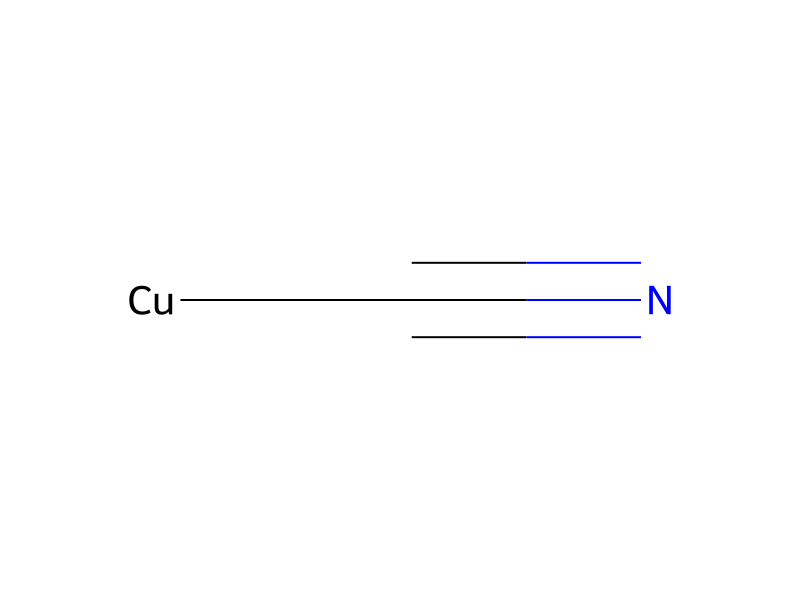
Br[C:2]1[C:11]2[C:6](=[CH:7][CH:8]=[C:9]([CH3:12])[CH:10]=2)[N:5]=[C:4]([CH3:13])[CH:3]=1.[C:14]([Cu])#[N:15]>CN(C=O)C>[C:14]([C:2]1[C:11]2[C:6](=[CH:7][CH:8]=[C:9]([CH3:12])[CH:10]=2)[N:5]=[C:4]([CH3:13])[CH:3]=1)#[N:15]Participants
4
Reactant 2

Product 1

Reagents, catalysts & solvents 1

Procedure
First, 4-bromo-2,6-dimethylquinoline (5.0 g) and CuCN (4.82 g) were added to DMF (70 ml) and were allowed to react for 6 hours at a temperature of 140° C. Ice was poured to the reaction solution and the produced precipitate was removed through filtering. The filtrate was extracted using ethyl acetate, the solvent was removed under reduced pressure, and the residue was purified through column chromatography (silica gel, hexane/ethyl acetate=4/1) to obtain 4-cyano-2,6-dimethylquinoline (2.14 g) represented by the following chemical formula (47).
Workup
- customto react for 6 hours at a temperature of 140° C
- additionIce was poured to the reaction solution
- customthe produced precipitate was removed
- filtrationthrough filtering
- extractionThe filtrate was extracted
- customthe solvent was removed under reduced pressure
- customthe residue was purified through column chromatography (silica gel, hexane/ethyl acetate=4/1)
Sources & evidence
- ORD record
- ord-ace30e94cb794f45b8109612a8052ec2
- Source dataset
- uspto-grants-2004_05
- Patent number
- US06730418B2
Reaction notes
Loading…