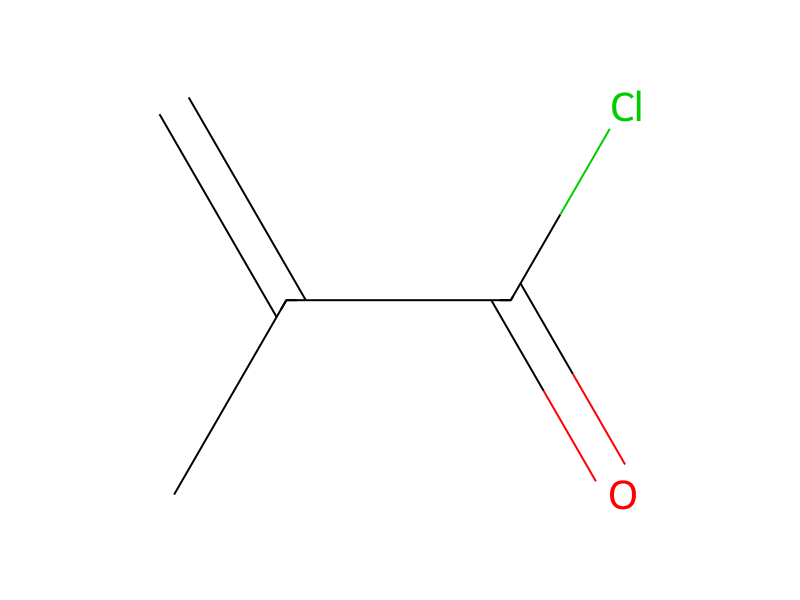
Methacryloyl chloride → 2-(2-Carbazol-9-ylethoxy)ethyl 2-methylprop-2-enoate
Reaction equation

[CH:1]1[C:13]2[N:12]([CH2:14][CH2:15][O:16][CH2:17][CH2:18][OH:19])[C:11]3[C:6](=[CH:7][CH:8]=[CH:9][CH:10]=3)[C:5]=2[CH:4]=[CH:3][CH:2]=1.[C:20](Cl)(=[O:24])[C:21]([CH3:23])=[CH2:22]>C(Cl)(Cl)(Cl)Cl>[CH:10]1[C:11]2[N:12]([CH2:14][CH2:15][O:16][CH2:17][CH2:18][O:19][C:20](=[O:24])[C:21]([CH3:23])=[CH2:22])[C:13]3[C:5](=[CH:4][CH:3]=[CH:2][CH:1]=3)[C:6]=2[CH:7]=[CH:8][CH:9]=1Participants
Reactant 2

Product 1

Reagents, catalysts & solvents 1

Procedure
1.05 g (4.12 mmol) 4 and 0.65 g (6.22 mmol) methacryloyl chloride were dissolved in 15 ml of carbon tetrachloride. After the addition of 2.6 g activated molecular sieves (3 Å), the mixture was heated to reflux for 24 h. After cooling down to room temperature, it was filtered over basic alumina using 20% THF in CCl4. Evaporating the solvent yielded 0.8 g (60.1%) of a viscous yellow oil. Rf=0.44 (EtOAc/hexanes: 2/8). 1H NMR (CDCl3, 500 MHz, 20° C.): d 8.10 (t, 2H, J=7.76 Hz), 7.44 (m, 4H), 7.23 (m, 2H), 5.99 (s, 1H), 5.51 (s, 1H), 4.49 (t, 2H, 5.95 Hz), 4.19 (t, 2H, J=4.75 Hz), 3.88 (t, 2H, J=5.95 Hz), 3.59 (t, 2H, J=4.75 Hz), 1.88 (s, 3H). 13C NMR (CDCl3, 125 MHz, 20° C.): d 167.3, 140.6, 136.0, 125.8, 125.7, 122.9, 120.3, 119.0, 108.8, 69.5, 69.3, 63.7, 43.2, 18.2.
Workup
- additionAfter the addition of 2.6 g
- temperaturethe mixture was heated
- temperatureto reflux for 24 h
- filtrationit was filtered over basic alumina using 20% THF in CCl4
- customEvaporating the solvent
Sources & evidence
- ORD record
- ord-215b314cb15d4964a09d11cbd905ffcf
- Source dataset
- uspto-grants-2004_05
- Patent number
- US06733883B2
Reaction notes
Loading…