Hydrogen Peroxide → 1-Phenyl-7-oxabicyclo[4.1.0]heptane
Reaction equation

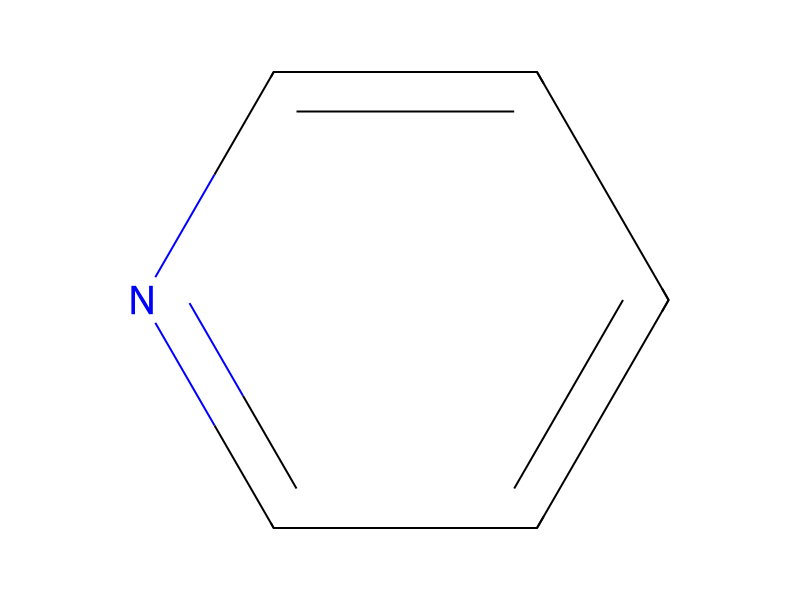
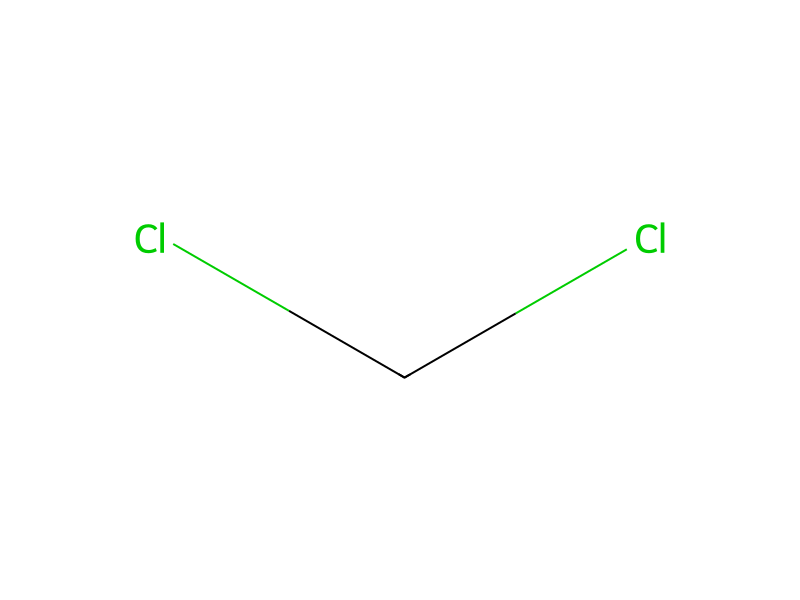
C[N+]([O-])=O.[C:5]1([C:11]2[CH2:16][CH2:15][CH2:14][CH2:13][CH:12]=2)[CH:10]=[CH:9][CH:8]=[CH:7][CH:6]=1.N1C=CC=CC=1.[OH:23]O>C(Cl)Cl>[C:5]1([C:11]23[O:23][CH:12]2[CH2:13][CH2:14][CH2:15][CH2:16]3)[CH:10]=[CH:9][CH:8]=[CH:7][CH:6]=1Participants
Reactant 4



Product 1

Reagents, catalysts & solvents 1
Procedure
The wide scope of this process is revealed in FIGS. 5-8 and 15-16. Due to practical considerations, we used CH2Cl2 as solvent for all examples even though CH3NO2 is slightly superior with regard to reaction rate. Standard experimental procedure (exemplified for the epoxidation of 1-phenyl-cyclohexene) is as follows: In a 50 mL flask equipped with a magnetic stirrer, 7.9 g (50 mmol) of 1-phenylcyclohexene and 63 mg (0.25 mmol, 0.5 mol %) of MTO are dissolved in 25 mL CH2Cl2. To this solution is added 0.48 mL (6 mmol, 12 mol %) of pyridine followed by 7.6 mL (75 mmol; 1.5 equivalents) of 30% aqueous H2O2 added dropwise from a syringe (circa 5-10 minutes). During the H2O2 -addition the temperature is kept at 20-25° C. by applying an external cooling bath. The reaction is complete after 6 h and the aqueous phase is separated and discarded. The remaining H2O2 in the yellow organic phase is decomposed to O2 and H2O by stirring with a catalytic amount of MnO2 (circa 5 mg). After the yellow color has completely disappeared the mixture is dried over Na2SO4, concentrated, and purified by filtration through a short column of silica gel which has been deactivated with NEt3. The column is washed with hexane/CH2Cl2 and concentration of the eluate affords 7.9 g (91%) of 1-phenyl-1,2-epoxycyclohexane as a colorless oil).
Workup
- customis slightly superior with regard to reaction rate
- customIn a 50 mL flask equipped with a magnetic stirrer
- additionadded dropwise from a syringe (circa 5-10 minutes)
- customis kept at 20-25° C.
- customthe aqueous phase is separated
- dry with materialis dried over Na2SO4
- concentrationconcentrated
- filtrationpurified by filtration through a short column of silica gel which
- washThe column is washed with hexane/CH2Cl2 and concentration of the
Sources & evidence
- ORD record
- ord-47ec9c5804c1427ab8784aab98bb29ef
- Source dataset
- uspto-grants-1999_08
- Patent number
- US05939568
Reaction notes
Loading…