Pyridine → 1-(4-Bromobutyl)-4-nitrobenzene
Reaction equation

N1C=CC=CC=1.[N+:7]([C:10]1[CH:15]=[CH:14][C:13]([CH:16](O)[CH2:17][CH2:18][CH3:19])=[CH:12][CH:11]=1)([O-:9])=[O:8].[Br:21]P(Br)(C1C=CC=CC=1)(C1C=CC=CC=1)C1C=CC=CC=1>C(#N)C>[Br:21][CH2:19][CH2:18][CH2:17][CH2:16][C:13]1[CH:14]=[CH:15][C:10]([N+:7]([O-:9])=[O:8])=[CH:11][CH:12]=1Participants
5
Reactant 3

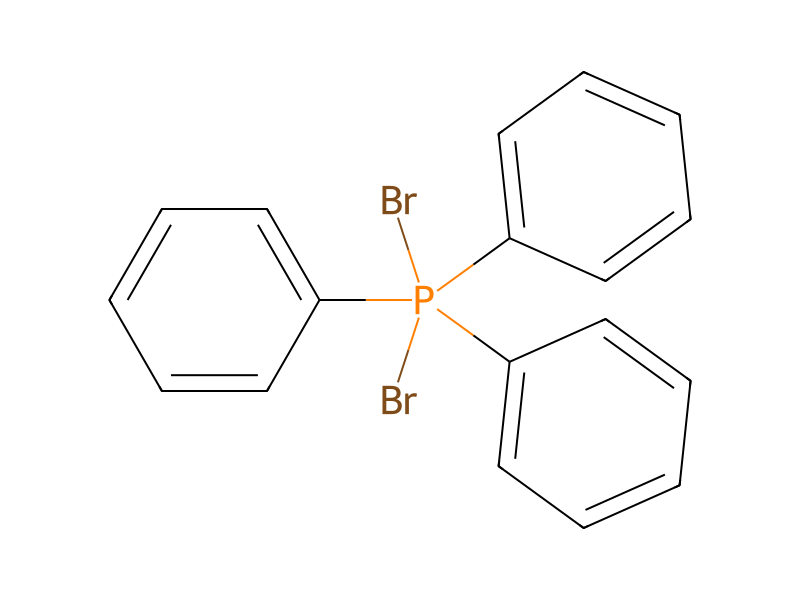

Product 1

Reagents, catalysts & solvents 1

Procedure
Part A. Pyridine (0.66 mL, 8.21 mmol) was added slowly to an ice cooled solution of 4-nitrophenyl butanol (1.0 gm,5.13 mmol) and dibromotriphenylphosphorane (2.8 gm, 6.66 mmol) in 20 mL acetonitrile under a nitrogen atmosphere. The reaction solution was stirred for 1/2 hr and allowed to warm to ambient temperature and stir overnight. The reaction was concentrated invacuo to give a residue. The residue was filtered through a short plug of silica gel and then the product was purifed by flash chromatography on silica gel eluting methylene chloride:hexane (v:v, 50:50), to give 1-bromo-4-(4-nitrophenyl)butane as an oil 1.3 gm (98%) MS 275(M+NH4)+ 1 H NMR (CDCl3): 8.2(d, 2H), 7.4(d, 2H), 3.4(t, 2H), 2.8(t, 2H), 1.8-2.0(m, 4H).
Workup
- stirringstir overnight
- concentrationThe reaction was concentrated invacuo
- customto give a residue
- filtrationThe residue was filtered through a short plug of silica gel
- washeluting methylene chloride
Sources & evidence
- ORD record
- ord-58d06552f3b34e6887aefcd4108e4e15
- Source dataset
- uspto-grants-1999_08
- Patent number
- US05942544
Reaction notes
Loading…