4-Bromobenzaldehyde → HCID 5151110, compound
Reaction equation

[Br:1][C:2]1[CH:9]=[CH:8][C:5]([CH:6]=O)=[CH:4][CH:3]=1.C1(P(=[CH:29][CH:30]=[O:31])(C2C=CC=CC=2)C2C=CC=CC=2)C=CC=CC=1>C(Cl)Cl>[Br:1][C:2]1[CH:9]=[CH:8][C:5]([CH:6]=[CH:29][CH:30]=[O:31])=[CH:4][CH:3]=1Participants
4
Reactant 2
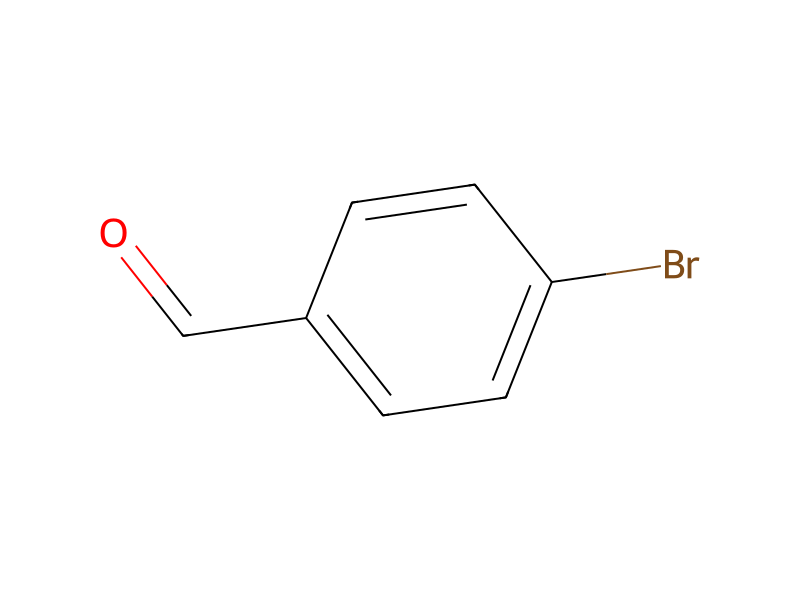

Product 1

Reagents, catalysts & solvents 1

Procedure
Part A. 4-bromobenzaldehyde (9.11 gm, 49.28 mmol) and (triphenylphosphoranylidene) acetaldehyde (15.00 gm, 49.28 mmol) were combined in 250 mL of methylene chloride and stirred overnight at room temperature. The volatiles were removed under vacuum and the residue dissolved in 200 mL of EtOAc, filtered through a pad of silica gel and concentrated to dryness. The resulting residue was purified by flash chromatography on silica gel eluting hexane:ethyl acetate (3:1, v:v) to give 3-(4-bromophenyl) acrolein as a pale yellow solid 3.67 gm, (35%). MS m/e 211 (M+H)+ 1 H NMR (CDCl3) 6.70 (dd, 1H), 7.43 (m, 3H), 7.54 (d, 2H), 9.69 (d, 1H).
Workup
- customThe volatiles were removed under vacuum
- dissolutionthe residue dissolved in 200 mL of EtOAc
- filtrationfiltered through a pad of silica gel
- concentrationconcentrated to dryness
- customThe resulting residue was purified by flash chromatography on silica gel
- washeluting hexane:ethyl acetate (3:1, v:v)
Sources & evidence
- ORD record
- ord-5262caeffb054c2ca1be9aa1380f6067
- Source dataset
- uspto-grants-1999_08
- Patent number
- US05942544
Reaction notes
Loading…