4-Nitrophthalimide → HCID 15707391, compound
Reaction equation

[N+:1]([C:4]1[CH:5]=[C:6]2[C:11](=[O:12])[NH:10][C:8](=[O:9])[C:7]2=[CH:13][CH:14]=1)([O-:3])=[O:2].[N:15]#[C:16]Br.C(N(CC)CC)C>CC(C)=O>[N+:1]([C:4]1[CH:5]=[C:6]2[C:7](=[CH:13][CH:14]=1)[C:8](=[O:9])[N:10]([C:16]#[N:15])[C:11]2=[O:12])([O-:3])=[O:2]Participants
Reactant 3
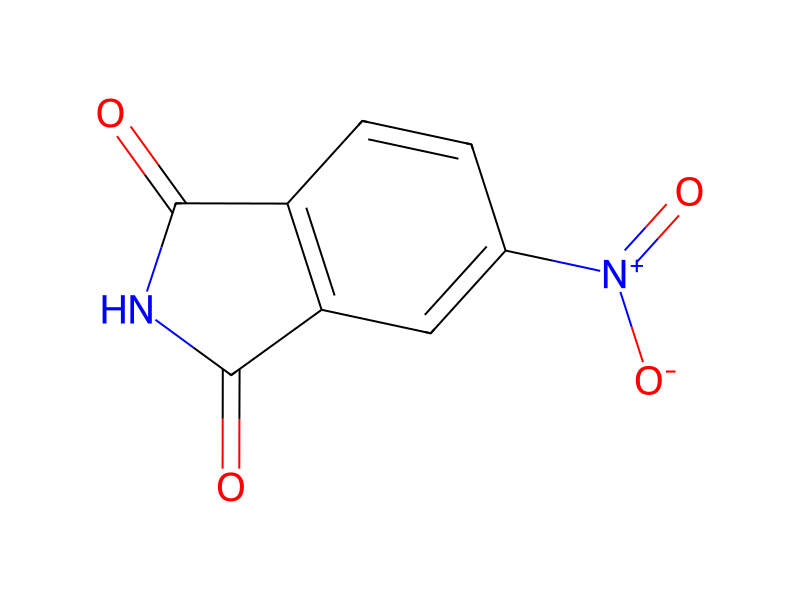

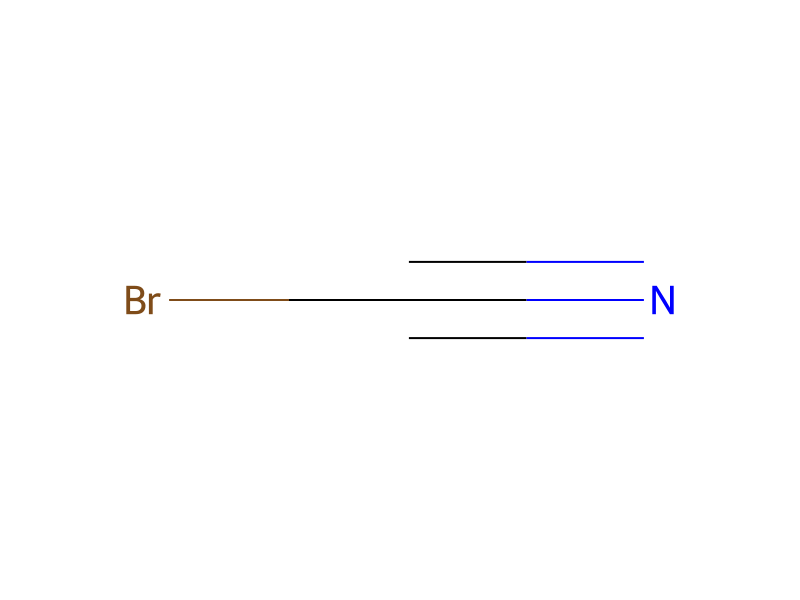
Product 1

Reagents, catalysts & solvents 1

Procedure
A 25 mL round-bottomed flask was charged with 4-nitrophthalimide (0.96 g, 5.0 mmol), cyanogen bromide (0.64 g, 6.0 mmol), and 10 mL of reagent grade acetone. The resulting suspension was cooled using an ice/salt bath, and triethylamine (1.0 mL, 7.1 mmol) was added dropwise over a 4 minute period. The mixture was allowed to stir for 20 minutes before being partitioned between ethyl acetate and water. The organic phase was washed with water, saturated brine, dried (MgSO4), and concentrated to give 0.95 g of a yellow solid. This material was recrystallized from ethyl acetate to afford 0.65 g (60%) of yellow crystals, mp 209.5°-210.5° C. (reported in Zh. Org. Khim. 1977, 13, 968 as 215° C.): IR (nujol) 2261 (nitrile), 1811 (carbonyl), 1769 (carbonyl), 1533 (nitro), 1343 (nitro) cm-1 ; 1H NMR (200 MHz, DMSO) δ 8.34 (d, 1, J=8.9 Hz), 8.70-8.78 (m, 2); 13C NMR (50 MHz, DMSO) δ 161.15, 160.92, 152.34, 135.19, 132.10, 131.16, 126.48, 119.76, 102.26; GC/MS (relative intensity) 217 (77.8), 149 (71.7), 103 (64.4), 75 (100), 74 (52.7).
Workup
- temperatureThe resulting suspension was cooled
- custombefore being partitioned between ethyl acetate and water
- washThe organic phase was washed with water, saturated brine
- dry with materialdried (MgSO4)
- concentrationconcentrated
Sources & evidence
- ORD record
- ord-b93c6a65b9214456993f393cc894332b
- Source dataset
- uspto-grants-1993_06
- Patent number
- US05216173
Reaction notes
Loading…