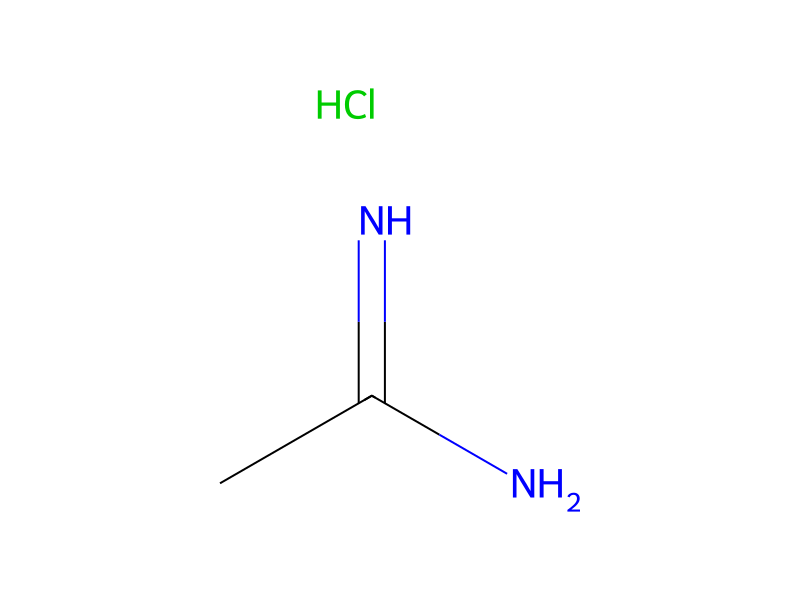
Acetamidine monohydrochloride → HCID 178440130, compound
Reaction equation

[Na].Cl.[C:3]([NH2:6])(=[NH:5])[CH3:4].[N+:7]([C:10]1[CH:27]=[CH:26][C:13]([CH2:14][CH:15]([C:21](=O)[CH2:22][CH2:23][CH3:24])[C:16](OCC)=[O:17])=[CH:12][CH:11]=1)([O-:9])=[O:8]>C(O)C>[CH2:22]([C:21]1[N:6]=[C:3]([CH3:4])[N:5]=[C:16]([OH:17])[C:15]=1[CH2:14][C:13]1[CH:12]=[CH:11][C:10]([N+:7]([O-:9])=[O:8])=[CH:27][CH:26]=1)[CH2:23][CH3:24]Participants
Reactant 3


Product 1

Reagents, catalysts & solvents 1

Procedure
3.5 g of sodium are dissolved in 175 ml of ethanol. 9.5 g of acetamidine hydrochloride are added to this solution and the mixture is stirred for 5 minutes at room temperature. 20 g of ethyl 2-(4-nitrobenzyl)-3-oxohexanoate, prepared in Example 3, are then added and the mixture is stirred for 4 days at room temperature. The solvents are then evaporated off under vacuum and the residue is taken up with hydrochloric acid solution and extracted with ethyl acetate. The organic phase is dried over magnesium sulphate and then evaporated under vacuum to give an oily residue which crystallises in an acetone/ether mixture. The crystals are drained and dried and give 10.9 g of 6-n-propyl-2-methyl-4-hydroxy-5-(4-nitrobenzyl)pyrimidine in the form of crystals of melting point 200° C.
Workup
- additionare then added
- stirringthe mixture is stirred for 4 days at room temperature
- customThe solvents are then evaporated off under vacuum
- extractionextracted with ethyl acetate
- dry with materialThe organic phase is dried over magnesium sulphate
- customevaporated under vacuum
- customto give an oily residue which
- customcrystallises in an acetone/ether mixture
- customdried
Sources & evidence
- ORD record
- ord-36a4f1f6af98495da75527ffc4703f21
- Source dataset
- uspto-grants-1993_06
- Patent number
- US05217973
Reaction notes
Loading…