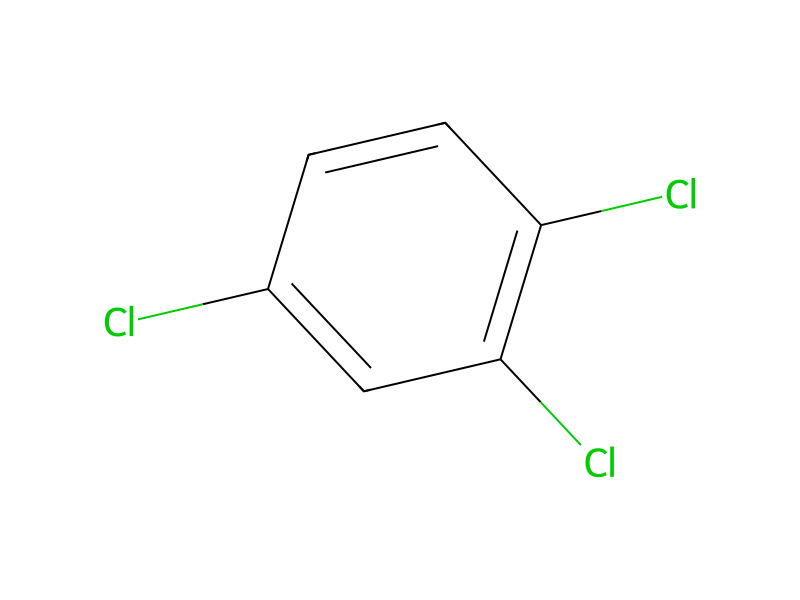
1,2-Dichlorobenzene → 1,2,4-Trichlorobenzene
Reaction equation

[Cl:1]Cl.C(=O)([O-])[O-].[Na+].[Na+].[Cl:9][C:10]1[CH:15]=[CH:14][CH:13]=[CH:12][C:11]=1[Cl:16]>>[Cl:9][C:10]1[CH:15]=[CH:14][CH:13]=[C:12]([Cl:1])[C:11]=1[Cl:16].[Cl:9][C:10]1[CH:15]=[CH:14][C:13]([Cl:1])=[CH:12][C:11]=1[Cl:16]Participants
5




Procedure
The o-dichlorobenzene and the catalyst are introduced into the reaction vessel and the chlorine is passed in until a certain density is reached. After completion of the reaction, the chlorination product is neutralised, for example with sodium carbonate, washed with water and distilled in vacuo. A mixture which essentially contains 1,2,3-trichlorobenzene and 1,2,4-trichlorobenzene is obtained; the two isomers can be separated by fractional distillation in the usual manner.
Workup
- customAfter completion of the reaction
- washwashed with water
- distillationdistilled in vacuo
Sources & evidence
- ORD record
- ord-553cb0e50b0f4b42a3ffe0e1626b7c71
- Source dataset
- uspto-grants-1986_02
- Patent number
- US04570023
Reaction notes
Loading…