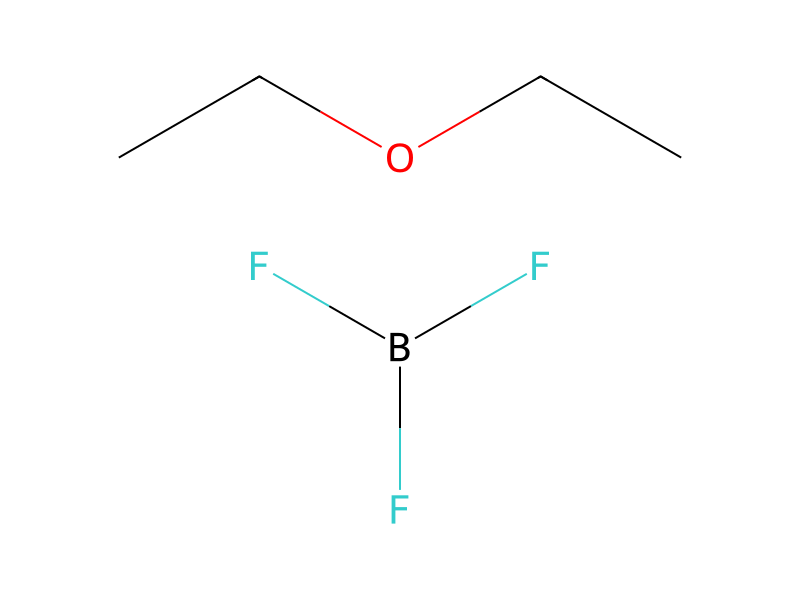
Boron trifluoride etherate → HCID 19767508, compound
Reaction equation

B(F)(F)F.CCOCC.[I:10][C:11]1[CH:30]=[CH:29][C:14]([C:15]([O:17][CH:18]([C:27]#[N:28])[C:19]2([CH:23]3[CH2:26][CH2:25][CH2:24]3)[CH2:22][O:21][CH2:20]2)=[O:16])=[CH:13][CH:12]=1.C(N(CC)CC)C>ClCCl>[C:27]([CH:18]1[C:19]2([CH:23]3[CH2:24][CH2:25][CH2:26]3)[CH2:22][O:21][C:15]([C:14]3[CH:13]=[CH:12][C:11]([I:10])=[CH:30][CH:29]=3)([O:16][CH2:20]2)[O:17]1)#[N:28]Participants
5
Reactant 3


Product 1

Reagents, catalysts & solvents 1

Procedure
Boron trifluoride etherate (1 ml) was added to a stirred solution of 1-cyano-1(3-cyclobutyloxetan-3-yl)methyl 4-iodobenzoate (2.3 g, 5.8 mmol) in dry dichloromethane (30 ml) at -70° C. under a nitrogen atmosphere. The solution was allowed to warm to room temperature and was stirred overnight. Triethylamine (1 ml) was added, the solution was evaporated to dryness to leave a gum which was partitioned between water and dichloromethane. The organic layer was separated, dried over anhydrous potassium carbonate and evaporated. The residue was chromatographed on basic alumina, eluting with hexane:dichloromethane (4:1 v/v) to give 3-cyano-4-cyclobutyl-1(4-iodophenyl)-2,6,7-trioxabicyclo[2.2.2]octane as a white solid (1.05 g, 46%).
Workup
- customthe solution was evaporated to dryness
- customto leave a gum which
- customwas partitioned between water and dichloromethane
- customThe organic layer was separated
- dry with materialdried over anhydrous potassium carbonate
- customevaporated
- customThe residue was chromatographed on basic alumina
- washeluting with hexane:dichloromethane (4:1 v/v)
Sources & evidence
- ORD record
- ord-be937825ef6b4effba2e92d1e23fbf74
- Source dataset
- uspto-grants-1993_04
- Patent number
- US05204333
Reaction notes
Loading…