Hydrogen Peroxide → 3-Bromo-2-methylpyridine N-oxide
Reaction equation

[Br:1][C:2]1[C:3]([CH3:8])=[N:4][CH:5]=[CH:6][CH:7]=1.[OH:9]O>CC(O)=O>[Br:1][C:2]1[C:3]([CH3:8])=[N+:4]([O-:9])[CH:5]=[CH:6][CH:7]=1Participants
Reactant 2

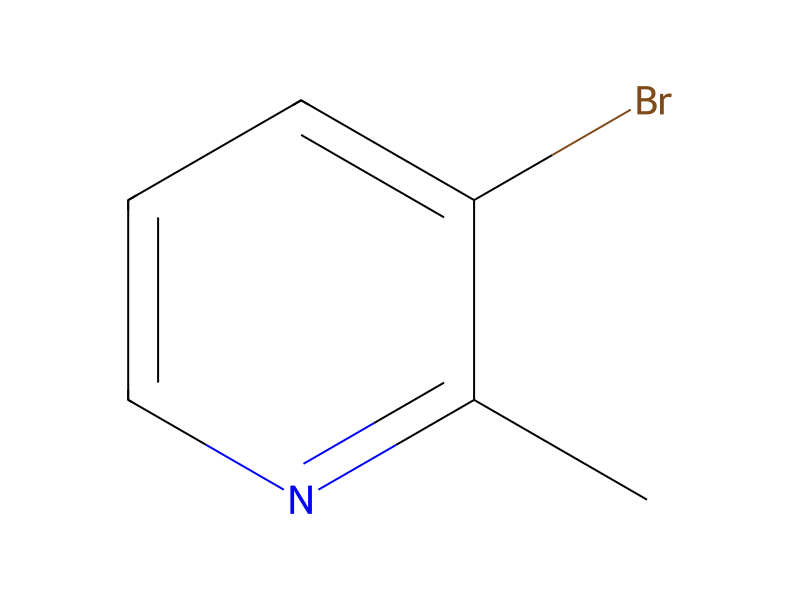
Product 1

Reagents, catalysts & solvents 1

Conditions
- Temperature
- 70 °C
Procedure
To a stirred solution of 3-Bromo-2-methyl-pyridine (1.96 g, 11.4 mmol) in glacial HOAc (20 mL) at room temperature was added 50% H2O2 (0.77 mL) and the solution was heated to 70° C. After 2 h, the reaction mixture was cooled to room temperature, additional H2O2 (0.80 mL) was added, and the solution was heated at 70° C. overnight. The reaction mixture was cooled to room temperature and concentrated under reduced pressure. The residue was dissolved in CH2Cl2 (80 mL) and treated with saturated aqueous NaHCO3 (20 mL). The aqueous phase was separated and extracted with CH2Cl2 (4×20 mL). The combined organic extracts were dried (Na2SO4), filtered, and concentrated to provide 3-Bromo-2-methyl-pyridine 1-oxide (1.79 g, 84%) as a white solid. 1H NMR (CDCl3) δ 2.70 (s, 3H), 7.00 (t, 1H, J=7.0 Hz), 7.44 (d, 1H, J=7.9 Hz), 8.23 (d, 1H, J=6.5 Hz). 3-Bromo-2-methyl-pyridine 1-oxide was used without further purification.
Workup
- temperaturethe reaction mixture was cooled to room temperature
- temperaturethe solution was heated at 70° C. overnight
- temperatureThe reaction mixture was cooled to room temperature
- concentrationconcentrated under reduced pressure
- dissolutionThe residue was dissolved in CH2Cl2 (80 mL)
- additiontreated with saturated aqueous NaHCO3 (20 mL)
- customThe aqueous phase was separated
- extractionextracted with CH2Cl2 (4×20 mL)
- dry with materialThe combined organic extracts were dried (Na2SO4)
- filtrationfiltered
- concentrationconcentrated
Sources & evidence
- ORD record
- ord-c66d8203b8804781b193f45725b63612
- Source dataset
- uspto-grants-2007_11
- Patent number
- US07291631B2
Reaction notes
Loading…