4-Chlorobenzoyl chloride → 4-Chloro-N-[3-(1H-imidazol-1-yl)propyl]benzamide
Reaction equation

[NH2:1][CH2:2][CH2:3][CH2:4][N:5]1[CH:9]=[CH:8][N:7]=[CH:6]1.C(N(C(C)C)CC)(C)C.[Cl:19][C:20]1[CH:28]=[CH:27][C:23]([C:24](Cl)=[O:25])=[CH:22][CH:21]=1>C(Cl)Cl>[N:5]1([CH2:4][CH2:3][CH2:2][NH:1][C:24](=[O:25])[C:23]2[CH:27]=[CH:28][C:20]([Cl:19])=[CH:21][CH:22]=2)[CH:9]=[CH:8][N:7]=[CH:6]1Participants
Reactant 3

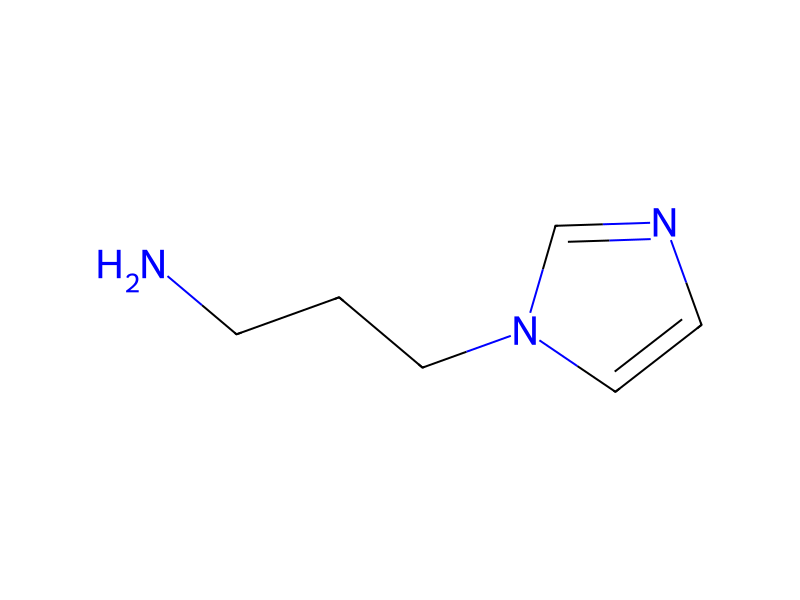

Product 1

Reagents, catalysts & solvents 1

Procedure
To a solution of 1-(3-amino-propyl)imidazole (2.1 g, 16.8 mmol), diisopropyl-ethylamine (3.5 mL, 20.0 mmol) and 4-N,N-dimethyl-aminopyridine (200 mg, 1.7 mmol) in methylene chloride (15 mL) at 0° C. was added dropwise 4-chlorobenzoyl-chloride (2.1 mL, 16.8 mmol). The reaction was then allowed to warm to room temperature. After 5 hours, the reaction was diluted with methylene chloride, washed with 1N sodium hydroxide, brine, dried over anhydrous magnesium sulfate, filtered and concentrated in vacuo to provide a white solid. This material was washed with diethyl ether to provide N-(3-imidazol-1-yl-propyl)-4-chlorobenzamide. To a slurry of the above amide (1.58 g, 6.0 mmol) in tetrahydrofuran (30 mL) was slowly added lithium aluminum hydride (456 mg, 12.0 mmol) upon which the reaction became exothermic. The mixture was heated to 80° C., stirred for 1 hr, cooled to 0° C. and quenched by addition of water (0.5 mL), 15% sodium hydroxide (0.5 mL) and an additional 1.5 mL of water. The reaction was diluted with ethyl acetate, dried over anhydrous magnesium sulfate, filtered and concentrated in vacuo to provide compound 20.
Workup
- washwashed with 1N sodium hydroxide, brine
- dry with materialdried over anhydrous magnesium sulfate
- filtrationfiltered
- concentrationconcentrated in vacuo
- customto provide a white solid
- washThis material was washed with diethyl ether
Sources & evidence
- ORD record
- ord-0ba2636cc79c4b0cb7bfa3b0179ed285
- Source dataset
- uspto-grants-2001_09
- Patent number
- US06284778B1
Reaction notes
Loading…