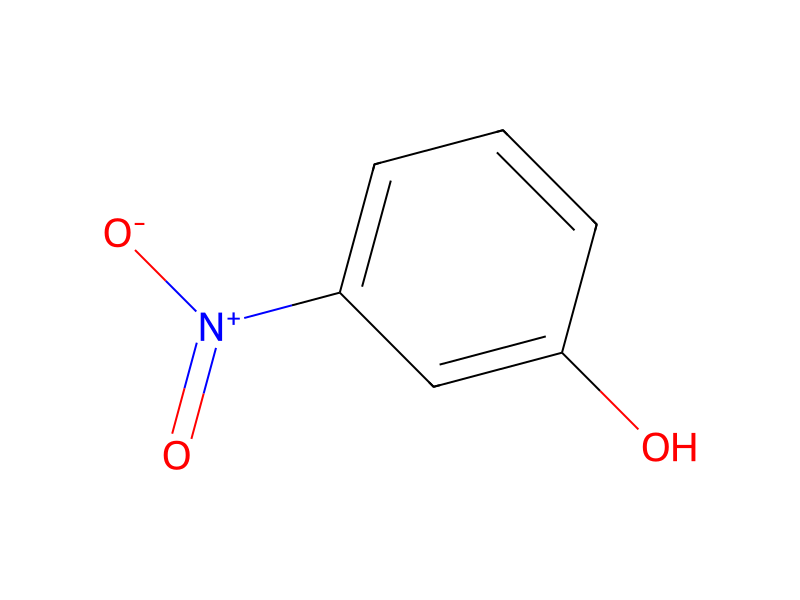
3-Nitrophenol → HCID 21701245, compound
Reaction equation

Cl[C:2]1([NH2:14])[CH:10]=[C:9]([N+:11]([O-:13])=[O:12])[CH:8]=[CH:7][CH:3]1[C:4]([OH:6])=[O:5].[N+]([C:18]1[CH:19]=[C:20]([OH:24])[CH:21]=[CH:22][CH:23]=1)([O-])=O.C(=O)([O-])[O-].[K+].[K+]>[N+](C1C=CC=CC=1)([O-])=O.C(O)C.[Cu]>[O:24]([C:2]1([NH2:14])[CH:10]=[C:9]([N+:11]([O-:13])=[O:12])[CH:8]=[CH:7][CH:3]1[C:4]([OH:6])=[O:5])[C:20]1[CH:21]=[CH:22][CH:23]=[CH:18][CH:19]=1Participants
7
Reactant 3


Product 1

Reagents, catalysts & solvents 3



Procedure
2-Chloro-4-nitroanthranilic acid (40.2 g, 0.2 mol) is stirred in nitrobenzene (250 mL) with 3-nitrophenol (31 g, 0.22 mol), potassium carbonate (42 g, 0.3 mole), copper bronze (1 g) and cuprous iodide (1 g) at 155° C. for 6 hours. The pure product is obtained by recrystallization in ethyl alcohol to give 2-phenoxy-4-nitroanthranilic acid. (See Goldberg, Walker, J. Chem. Soc. (1953), 1348).
Sources & evidence
- ORD record
- ord-ccb6b857244f4fd395b837dd2d8b614f
- Source dataset
- uspto-grants-2001_09
- Patent number
- US06291442B1
Reaction notes
Loading…