Triethylamine → HCID 178515078, compound
Reaction equation

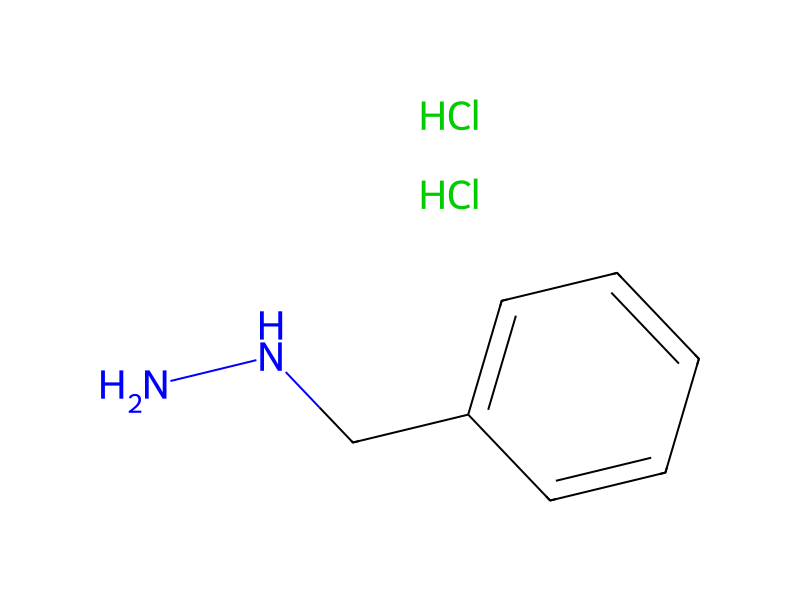
[Cl:1][C:2]1[CH:11]=[C:10]2[C:5]([C:6]([OH:20])=[C:7]([C:16]([O:18]C)=O)[C:8]([C:12]([O:14]C)=O)=[N:9]2)=[CH:4][CH:3]=1.Cl.Cl.[CH2:23]([NH:30][NH2:31])[C:24]1[CH:29]=[CH:28][CH:27]=[CH:26][CH:25]=1.C(N(CC)CC)C>C(O)C>[CH2:23]([N:30]1[C:16](=[O:18])[C:7]2[C:6](=[O:20])[C:5]3[CH:4]=[CH:3][C:2]([Cl:1])=[CH:11][C:10]=3[NH:9][C:8]=2[C:12]([OH:14])=[N:31]1)[C:24]1[CH:29]=[CH:28][CH:27]=[CH:26][CH:25]=1Participants
Reactant 3


Product 1

Reagents, catalysts & solvents 1

Procedure
To a stirred suspension of dimethyl 7-chloro-4-hydroxyquinoline-2,3-dicarboxylate (5.00 g, 16.90 mM) and benzyl hydrazine dihydrochloride (46.15 g, 236.50 mM) in ethanol (100 mL) was added triethylamine (75.8 mL, 541.0 mM). The mixture was heated to give a brown solution which was refluxed for 40 hours during which time a precipitate formed. The suspension was cooled to room temperature and filtered to give the benzyl hydrazine salt of the title compound as an impure yellow solid. Multiple crystallizations from ethanolic hydrogen chloride and methanol gave the title compound (0.370 g, 6%) as a white powder, mp=347°-350° C.; MS(CI): 354 (M+H). Analysis for C18H2ClN3O3 : Calculated: C, 61.10; H, 3.42; N, 11.90; Found: C, 60.68; H, 3.61; N, 11.80; NMR: 12.65 (br s, 1H, exchangeable), 11.93 (br s, 1H, exchangeable), 8.15 (d, J=8.67 Hz, 1H), 8.02 (d, J=1.83, 1H), 7.43 (d, J=8.55 Hz, 1H), 7.36-7.23 (m, 5H), 5.11 (s,2H).
Workup
- temperatureThe mixture was heated
- customto give a brown solution which
- temperaturewas refluxed for 40 hours during which time a precipitate
- customformed
- filtrationfiltered
Sources & evidence
- ORD record
- ord-899ecb51e6464c9f9ea461c7d5cc7641
- Source dataset
- uspto-grants-1998_04
- Patent number
- US05744471
Reaction notes
Loading…