Dimethylformamide dimethyl acetal → Formononetin
Reaction equation

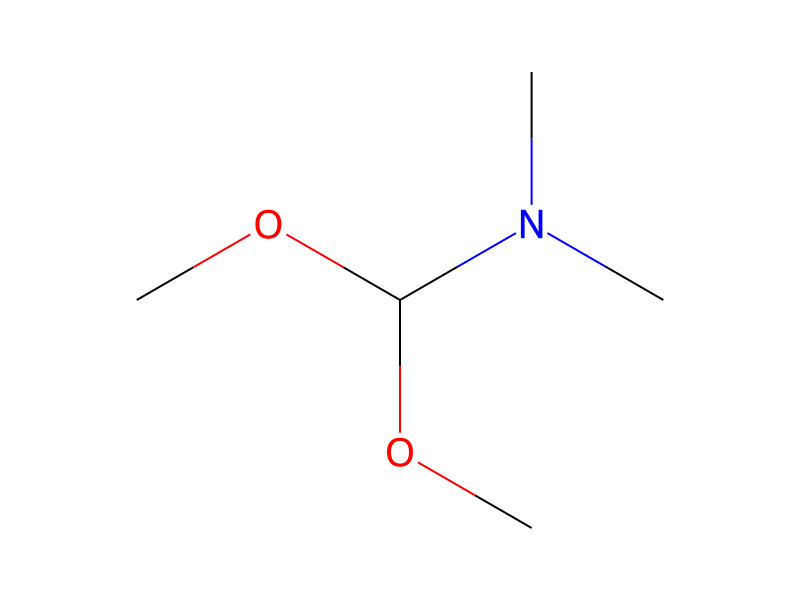
CO[CH:3]([O:7][CH3:8])N(C)C.O[C:10]1[CH:15]=[C:14]([OH:16])[CH:13]=C[C:11]=1[C:17]([CH2:19][C:20]1[CH:25]=[CH:24][C:23]([O:26][CH3:27])=[CH:22][CH:21]=1)=[O:18]>C1C=CC=CC=1>[CH3:27][O:26][C:23]1[CH:24]=[CH:25][C:20]([C:19]2[C:17](=[O:18])[C:11]3[CH:10]=[CH:15][C:14]([OH:16])=[CH:13][C:3]=3[O:7][CH:8]=2)=[CH:21][CH:22]=1Participants
Reactant 2

Product 1

Reagents, catalysts & solvents 1

Procedure
Another known approach used for the synthesis of formononetin is the general method involving the addition of one carbon to 2-hydroxydeoxybenzoins and their cyclization to form isoflavones. The method introduced by Andrew Pelter (Pelter, Andrew, et al., Synthesis, 5:326 (1976)) involves the reaction of 2-hydroxydeoxybenzoins with N,N-dimethylformamide dimethylacetal (dimethoxydimethyl aminomethane) (two equivalents) in dry benzene. Refluxing a mixture of 2,4-dihydroxy-4'-methoxydeoxybenzoin with N,N-dimethylformamide dimethyl acetal in dry benzene for 4 hours gave formononetin in 85% yield. However, the use of the expensive reagent, N,N-dimethylformamide dimethyl acetal and dry benzene as solvent makes this an unattractive method for the commercial production of formononetin.
Workup
- additionThe method introduced by Andrew Pelter (Pelter, Andrew, et al., Synthesis, 5:326 (1976))
- temperatureRefluxing
Sources & evidence
- ORD record
- ord-558be4afb2f74a10a6f4c31552fa4176
- Source dataset
- uspto-grants-1999_11
- Patent number
- US05981775
Reaction notes
Loading…