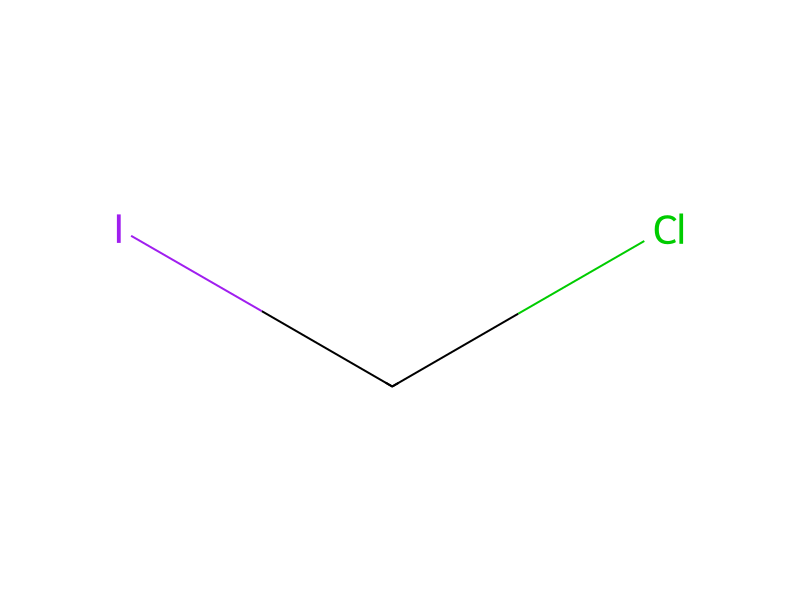
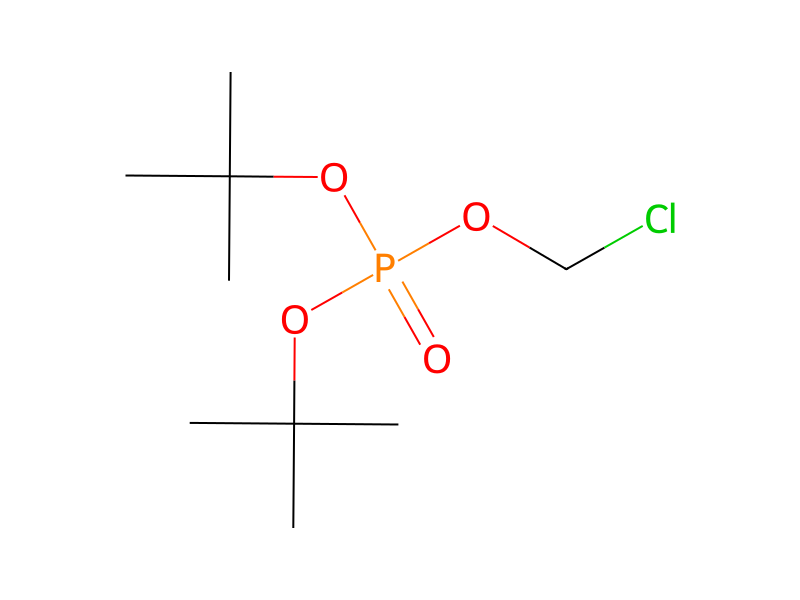
Chloroiodomethane → Di-tert-butyl (chloromethyl) phosphate
Reaction equation

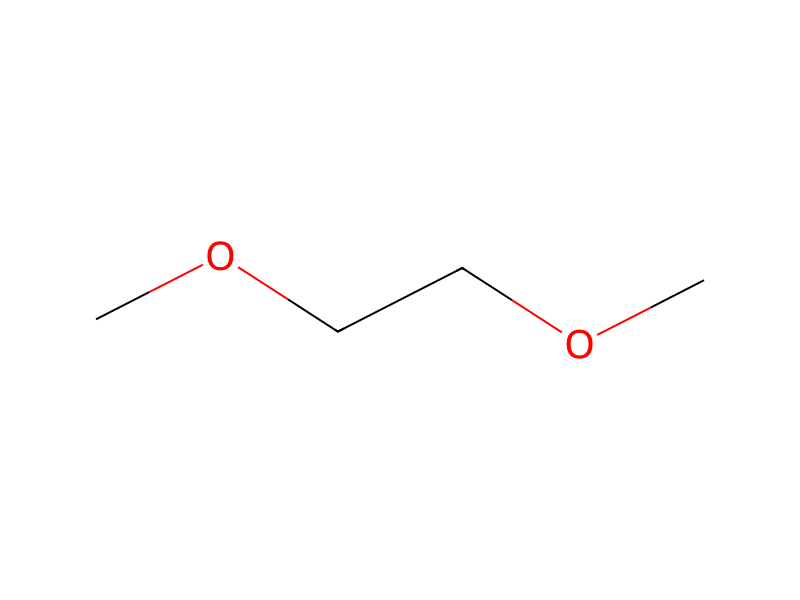
[C:1]([O:5][P:6]([O-:13])([O:8][C:9]([CH3:12])([CH3:11])[CH3:10])=[O:7])([CH3:4])([CH3:3])[CH3:2].C[N+](C)(C)C.[Cl:19][CH2:20]I>C(COC)OC>[P:6]([O:5][C:1]([CH3:4])([CH3:3])[CH3:2])([O:8][C:9]([CH3:12])([CH3:11])[CH3:10])([O:13][CH2:20][Cl:19])=[O:7]Participants
Reactant 2

Product 1
Reagents, catalysts & solvents 1
Procedure
The conversion of di-tert-butyl phosphite into the corresponding phosphate is performed by a slight modification of the method published by Zwierzak and Kluba (Zwierzak, A and Kluba, M., 1971). Di-tert-butyl phospohite (40.36 mmole) is combined with potassium bicarbonate (24.22 mmole) in 35 ml of water. The solution is stirred in an ice bath and potassium permanganate (28.25 mmole) is added in three equal portions over one hour's time. The reaction as then allowed to continue at room temperature for an additional half hour. Decolorizing carbon (600 mg) is then incorporated as the reaction is heated to 60° C. for 15 minutes. The reaction is then vacuum filtered to remove solid magnesium dioxide. The solid is washed several times with water. The filtrate is then combined with one gram of decolorizing carbon and heated at 60° C. for an additional twenty minutes. The solution is again filtered to yield a colorless solution, to which a slight excess of concentrated HCl is slowly added with efficient stirring in an ice bath. The addition of acid causes the precipitation of the di-tert-butyl phosphate free acid. The free acid is then filtered and washed with ice cold water. The compound is then converted to the salt form by dissolving the free acid in acetone and adding an equal molar amount of tetramethylammonium hydroxide while keeping the reaction cooled by a salt/ice bath with efficient stirring. The resulting clear solution is placed under reduced pressure to give 7.16 grams of crude product. This product is then recrystallized by refluxing in dimethoxyethane and slow cooling at room temperature to give 6.52 g of pure product (57% yield). 12.75 mmole of the tetramethylammonium di-tert-butyl-phosphate is then mixed with 70 ml of dimethoxyethane and brought to reflux. Twenty-five grams of chloroiodomethane is then added and stirred for one and a half hours. The reaction is then filtered and the filtrate is placed under reduced pressure to remove excess chloroiodomethane and solvent. The two products are then separated via flash column chromatography. The stationary phase is normal phase silica (30 g). The mobile phase consists of ethyl acetate and hexane in a 3 to 7 (v/v) ratio respectively. The chloromethyl di-tert-butyl phosphate is isolated as a pale gold oil (63% yield): 1H NMR (CDCl3, 300 MHz) δ 1.51 (s, 12H), 5.63 (d, 2H, J=14.8). Mass spectrum (FAB+, GLY) 259 (M+1).
Workup
- temperatureto reflux
- filtrationThe reaction is then filtered
- customto remove excess chloroiodomethane and solvent
- customThe two products are then separated via flash column chromatography
Sources & evidence
- ORD record
- ord-3ff50944821c4ed094bee00440784a90
- Source dataset
- uspto-grants-1999_11
- Patent number
- US05985856
Reaction notes
Loading…