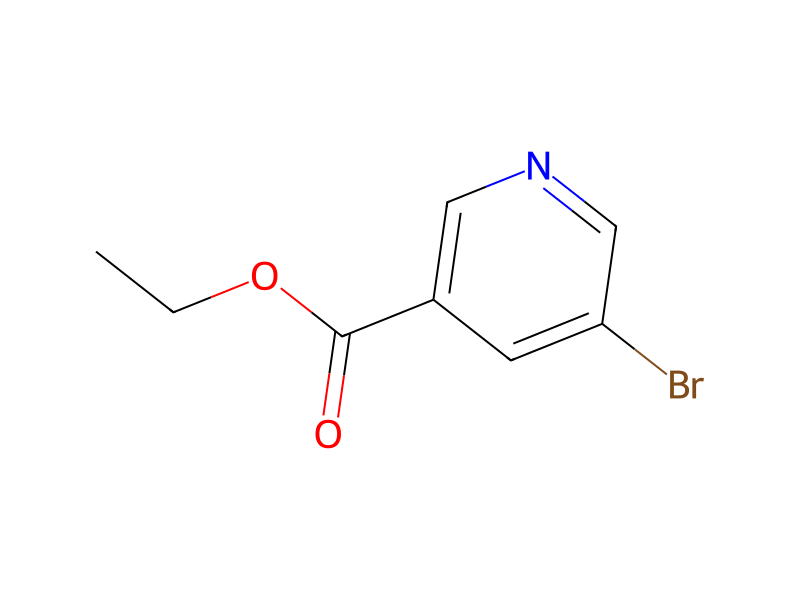
Ethyl 5-bromopyridine-3-carboxylate → HCID 18005196, compound
Reaction equation

[F:1][C:2]1[CH:7]=[CH:6][CH:5]=[C:4]([F:8])[C:3]=1[Sn](CCCC)(CCCC)CCCC.Br[C:23]1[CH:24]=[N:25][CH:26]=[C:27]([CH:33]=1)[C:28]([O:30][CH2:31][CH3:32])=[O:29]>C1(C)C(C)=CC=CC=1.[Pd].C1(P(C2C=CC=CC=2)C2C=CC=CC=2)C=CC=CC=1.C1(P(C2C=CC=CC=2)C2C=CC=CC=2)C=CC=CC=1.C1(P(C2C=CC=CC=2)C2C=CC=CC=2)C=CC=CC=1.C1(P(C2C=CC=CC=2)C2C=CC=CC=2)C=CC=CC=1>[F:8][C:4]1[CH:5]=[CH:6][CH:7]=[C:2]([F:1])[C:3]=1[C:23]1[CH:24]=[N:25][CH:26]=[C:27]([CH:33]=1)[C:28]([O:30][CH2:31][CH3:32])=[O:29]Participants
5




Procedure
A mixture of (2,6-difluorophenyl)tributyltin (1.18 g, 2.9 mmol), ethyl 5-bromonicotinate (0.69 g, 3 mmol) and tetrakis (triphenylphosphine) palladium (0) (0.10 g) in xylene (10 mL) was heated under reflux for 24 h, then cooled, filtered and evaporated. The residue was chromatographed on silica gel eluted with 20% ethyl acetate/petrol to give the title compound (0.64 g, 84%).
Workup
- temperaturewas heated
- temperatureunder reflux for 24 h
- temperaturecooled
- filtrationfiltered
- customevaporated
- customThe residue was chromatographed on silica gel
- washeluted with 20% ethyl acetate/petrol
Sources & evidence
- ORD record
- ord-09d7b52d8f7247fc811a5a08d54bdd64
- Source dataset
- uspto-grants-1999_11
- Patent number
- US05990133
Reaction notes
Loading…