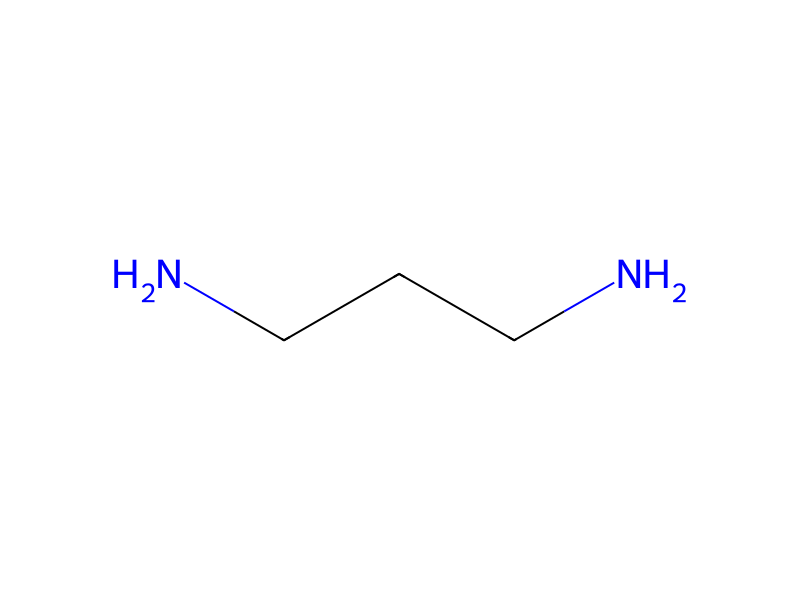
1,3-Propanediamine → (E)-(R)-2-Methyl-4-(2,2,3-trimethylcyclopent-3-en-1-yl)-2-butene-1-ol
Reaction equation

[CH3:1]/[C:2](=[CH:5]\[CH2:6][C@H:7]1[CH2:11][CH:10]=[C:9]([CH3:12])[C:8]1([CH3:14])[CH3:13])/[CH:3]=[O:4].CC1[C@H]2C(C)(C)[C@H](C2)CC=1.NCCCN.[OH-].[K+]>C(O)(C)C>[CH3:1]/[C:2](=[CH:5]\[CH2:6][C@H:7]1[CH2:11][CH:10]=[C:9]([CH3:12])[C:8]1([CH3:14])[CH3:13])/[CH2:3][OH:4]Participants
6



Procedure
In a 100 ml stainless steel autoclave were charged 3.84 g (0.02 mol) of (E)-(R)-2-methyl-4-(2,2,3-trimethylcyclopent-3-en-1-yl)-2-buten-1-al synthesized from (1S,5S)-α-pinene having an optical purity of 97% e.e. (available from Aldrich) in a conventional manner, 38.4 mg (0.04 mmol) of RuCl2 (PPh3)3, 4 ml of a 0.02M 1,3-diaminopropane (0.08 mmol) solution in isopropyl alcohol, and 12 ml of a 0.1M potassium hydroxide (1.2 mmol) solution in isopropyl alcohol in a nitrogen atmosphere, and the mixture was stirred at 0° C. for 3 hours under a hydrogen pressure of 50 atm.
Sources & evidence
- ORD record
- ord-57fd62a4bb2842a2a4dfd924f387ade2
- Source dataset
- uspto-grants-1999_11
- Patent number
- US05994291
Reaction notes
Loading…