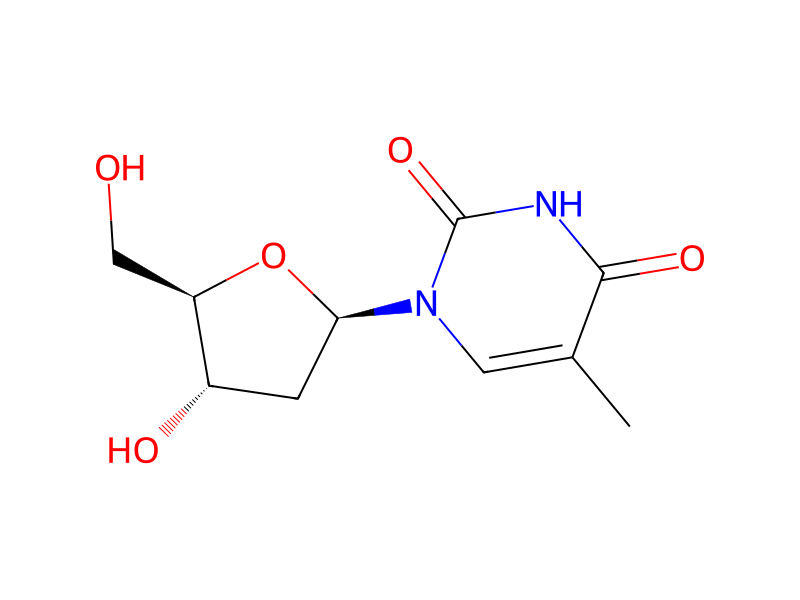
Thymidine → HCID 86754872, compound
Reaction equation

[C@@H:1]1([N:9]2[CH:17]=[C:15]([CH3:16])[C:13](=[O:14])[NH:12][C:10]2=[O:11])[O:8][C@H:5]([CH2:6][OH:7])[C@@H:3]([OH:4])[CH2:2]1.[CH3:18][CH2:19][N:20]=[C:21]=[N:22][CH2:23][CH2:24][CH2:25][N:26]([CH3:28])[CH3:27]>>[C@@H:1]1([N:9]2[CH:17]=[C:15]([CH3:16])[C:13](=[O:14])[NH:12][C:10]2=[O:11])[O:8][C@H:5]([CH2:6][OH:7])[C@@H:3]([OH:4])[CH2:2]1.[CH3:18][CH2:19][N:20]=[C:21]=[N:22][CH2:23][CH2:24][CH2:25][N:26]([CH3:28])[CH3:27]Participants

Procedure
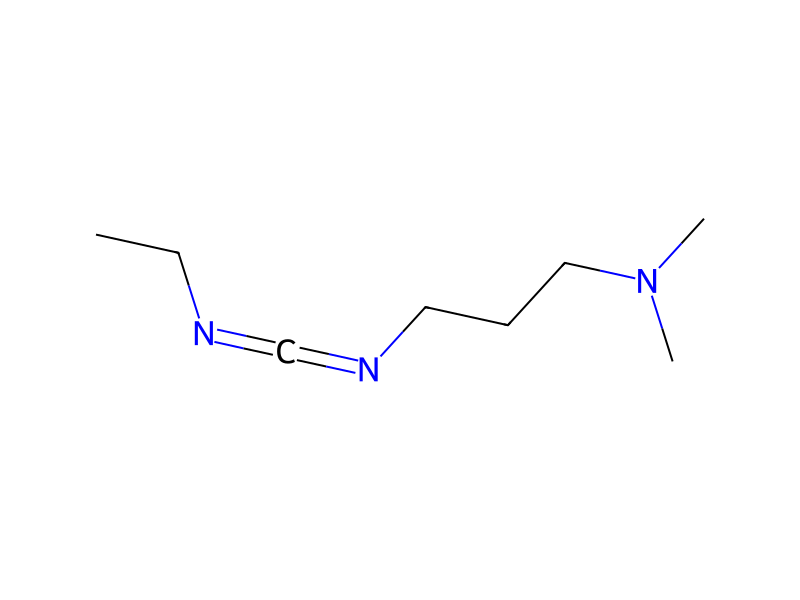
Synthesis and purification of YEE(ah-GalNAc)3 (5) (15a) and Um pT7 (6) (17) was carried according to established procedures. In order to form a covalent link between 5 and 6, the 5' end of 6 was modified using the method of Orgel (18). This introduced a disulfide into the oligo-MP, which in turn could be reduced with DTT to give a 5'-thiol. The neoglycopeptide 5 was modified in a complementary fashion using the heterobifunctional cross-linking reagent, SMCC, capable of combining with the N-terminal amino group of 5. Coupling of the maleimido group introduced by SMCC and the 5'-thiol of the modified oligo-MP resulted in linkage of the oligo-MP and neoglycopeptide via a metabolically stable thioether (FIG. 2). To begin the synthesis, 6 was phosphorylated using T4 polynucleotide kinase and 0.95 equivalents of ATP. Formulation of the end-labeling reaction in this way ensured that ca. 90% of the ATP was consumed allowing efficient use of the [32P]-ATP to radioactively label the conjugate. Modification of the 5' phosphate was accomplished in two steps. The end-labeled oligo-MP was incubated at 50° C. with 0.5 M cystamine hydrochloride in a buffer containing 0.1 M 1-methylimidazole at pH 7.2 in the presence of 0.15 M EDAC to give the 5' cystamine phosphoramidate in 65k yield. Up to 35% of thymidine-modified oligo-MP was produced during this reaction and, despite attempts to modify the reaction conditions (e.g., lowering the temperature and reducing the concentration of EDAC), its production could not be eliminated. This side product presumably arises due to reaction of EDAC with N-3 of thymidine to form a thymidine-EDAC adduct (19). Reduction of the disulfide with 50 mM DTT at pH 8 was quantitative. Although in this example a thiol was introduced onto the oligo-MP post-synthetically, in part to allow introduction Of 32 p enzymatically at the 5' terminus, the construction of the conjugate could as easily be carried out by introduction of a thiol linker during the solid phase synthesis of the oligo-MP using, for example, 6-(tritylthio)hexyl phosphoramidite (19) commercially available from Glen Research.
Workup
- customyield
- customwas produced during this reaction and, despite attempts
- customthe reaction conditions (e.g.
Sources & evidence
- ORD record
- ord-b784ee623ab04225a18d6193f730bfd6
- Source dataset
- uspto-grants-1999_11
- Patent number
- US05994517
Reaction notes
Loading…