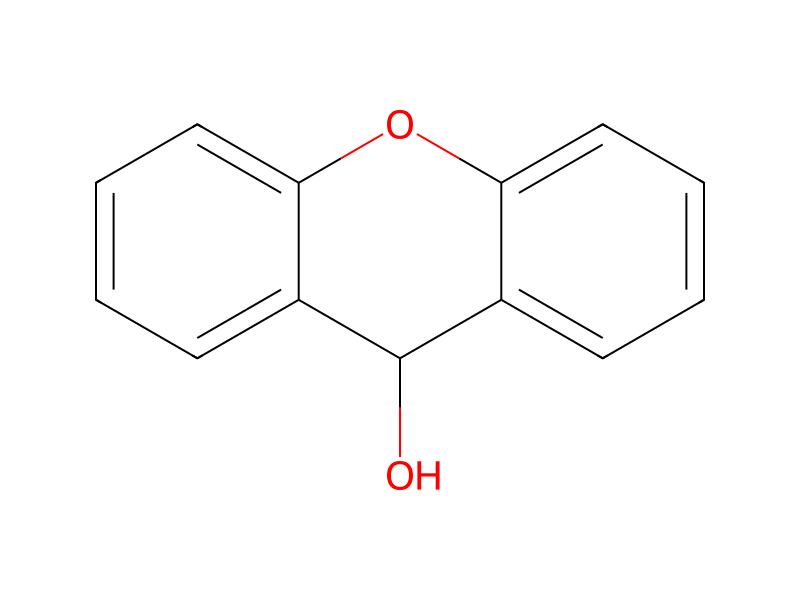
Phenol → Xanthydrol
Reaction equation

C1(O)C=CC=CC=1.C(=O)([O-])[O-].[K+].[K+].[O:14]([C:21]1[CH:29]=[CH:28][CH:27]=[CH:26][C:22]=1[C:23](O)=[O:24])[C:15]1[CH:20]=[CH:19][CH:18]=[CH:17][CH:16]=1.C1C2C(=O)C3C(=CC=CC=3)OC=2C=CC=1>C(O)C.[Cu].[Na].[Hg]>[CH:18]1[CH:19]=[C:20]2[CH:23]([OH:24])[C:22]3[C:21]([O:14][C:15]2=[CH:16][CH:17]=1)=[CH:29][CH:28]=[CH:27][CH:26]=3Participants
8
Reactant 4




Product 1
Reagents, catalysts & solvents 3



Procedure
The xanthydrols are either known to the art or are prepared by the following procedure. A 2-halobenzoic acid is reacted with a phenol preferably in the presence of a base such as potassium carbonate and in the presence of cuprous iodide and copper bronze. The resulting 2-phenoxybenzoic acid is cyclized by reacting with acid for example polyphosphoric acid. The resulting xanthone is reduced, for example using sodium amalgam in ethanol, to give the xanthydrol.
Workup
- customare prepared by the following procedure
Sources & evidence
- ORD record
- ord-49ad4d73ed9a44eab7c52ce0e2d6262b
- Source dataset
- uspto-grants-1976_04
- Patent number
- US03949076
Reaction notes
Loading…