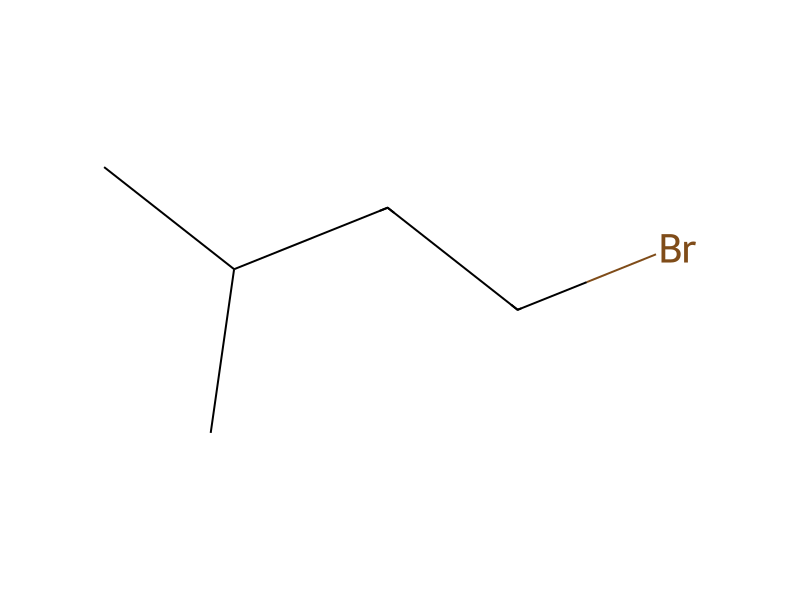
1-Bromo-3-methylbutane → 4-(3-Methylbutoxy)-2-nitrotoluene
Reaction equation

[N+:1]([C:4]1[C:9]([CH3:10])=[CH:8][CH:7]=[C:6]([OH:11])[CH:5]=1)([O-:3])=[O:2].[CH2:12](Br)[CH2:13][CH:14]([CH3:16])[CH3:15].C(=O)([O-])[O-].[K+].[K+]>CC(C)=O>[CH3:15][CH:14]([CH3:16])[CH2:13][CH2:12][O:11][C:6]1[CH:7]=[CH:8][C:9]([CH3:10])=[C:4]([N+:1]([O-:3])=[O:2])[CH:5]=1Participants
5
Reactant 3


Product 1

Reagents, catalysts & solvents 1

Procedure
A mixture of 50 parts of 3-nitro-p-cresol, 94 parts of isoamyl bromide and 94.2 parts of anhydrous potassium carbonate in 650 parts of acetone was stirred and heated under reflux for 18 hours. Insoluble material was filtered off and washed with acetone and the total acetone solution was evaporated. An oil remained which was partitioned between 250 parts of ether and 500 parts of water. The ethereal layer was isolated dried over anhydrous magnesium sulphate then evaporated to leave 66.6 parts of 4-(3-methylbutoxy)-2-nitrotoluene as a pale yellow oil.
Workup
- temperatureheated
- temperatureunder reflux for 18 hours
- filtrationInsoluble material was filtered off
- washwashed with acetone
- customthe total acetone solution was evaporated
- customwas partitioned between 250 parts of ether and 500 parts of water
- customThe ethereal layer was isolated
- dry with materialdried over anhydrous magnesium sulphate
- customthen evaporated
Sources & evidence
- ORD record
- ord-fa653e091d1a4f149fbf1e25c83f77cf
- Source dataset
- uspto-grants-1976_04
- Patent number
- US03952013
Reaction notes
Loading…