Trichloroacetic Acid → Trichloroacetic Acid
Reaction equation

[Cl:1][C:2]1[CH:7]=[CH:6][C:5]([I:8]=O)=[CH:4][CH:3]=1.[Cl:10][C:11]([Cl:16])([Cl:15])[C:12]([OH:14])=[O:13]>C(Cl)Cl>[Cl:10][C:11]([Cl:16])([Cl:15])[C:12]([OH:14])=[O:13].[Cl:1][C:2]1[CH:7]=[CH:6][C:5]([I:8])=[C:4]([O:13][C:12](=[O:14])[C:11]([Cl:16])([Cl:15])[Cl:10])[C:3]=1[O:14][C:12](=[O:13])[C:11]([Cl:16])([Cl:15])[Cl:10]Participants
Reactant 2
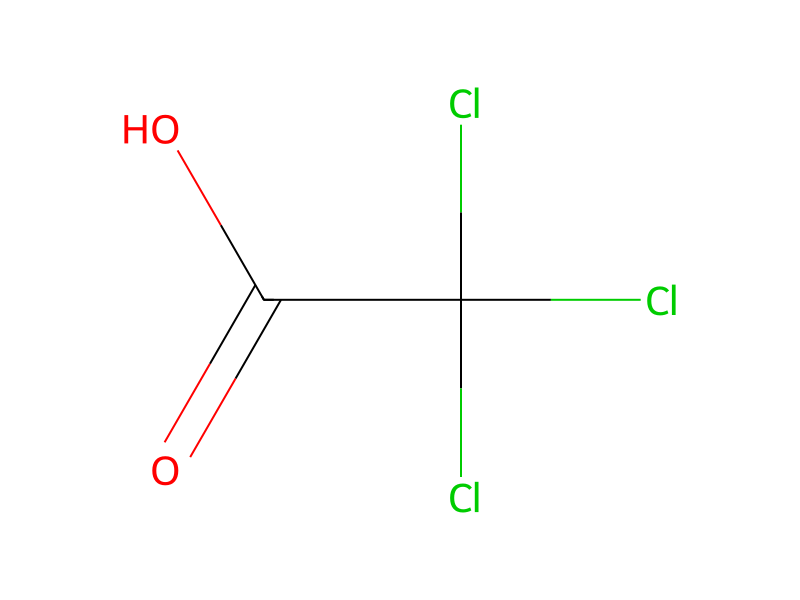

Product 2

Reagents, catalysts & solvents 1

Procedure
A quantity of 135 g. (0.53 mole) p-chloroiodosobenzene is suspended in 800 ml. of methylene chloride contained in a 2-liter Erlenmeyer flask. To the suspension is added 190 g. (1.16 mole) trichloroacetic acid dissolved in 500 ml. of methylene chloride with agitation over a 5-minute period, the reaction temperature being maintained at room temperature. After 30 minutes, the solution is filtered and solvent is removed under reduced pressure. The solid residue is triturated with ether and filtered. The solid is collected on the filter, washed with ether and dried. The slightly off-white crystalline solid thereby obtained melts with decomposition at 155°-157°C. The yield is 80-85%. The carbon, hydrogen and iodine analyses and infrared spectra are consistent with the named structure. The substitution of dichloroacetic acid for trichloroacetic acid gives the corresponding 4-chloro-bis(dichloroacetoxy)iodobenzene which melts at 111°-112°C. with decomposition.
Workup
- additionTo the suspension is added 190 g
- filtrationthe solution is filtered
- customsolvent is removed under reduced pressure
- customThe solid residue is triturated with ether
- filtrationfiltered
- customThe solid is collected on the filter
- washwashed with ether
- customdried
- customat 155°-157°C
Sources & evidence
- ORD record
- ord-93cbc3a98a184bb288fd3ac0de093bd4
- Source dataset
- uspto-grants-1976_04
- Patent number
- US03952028
Reaction notes
Loading…